Cement Removal Around Implant Crowns
Cement removal around implant crowns is one of the most underestimated but clinically important steps in implant prosthetics. A restoration may look excellent at delivery, yet if excess cement remains around the implant, biologic complications can develop slowly and become much harder to manage later.
Residual cement is a common contributing factor in peri-implant inflammation. For that reason, clinicians should not think of cementation as a simple finishing step. It is a biologic control step that directly affects tissue health, patient comfort, and long-term restorative stability.
This page explains why cement removal matters, why implant restorations are especially sensitive to residual cement, and how dentists can reduce risk through better margin planning, abutment design, crown contour control, and careful delivery protocol.
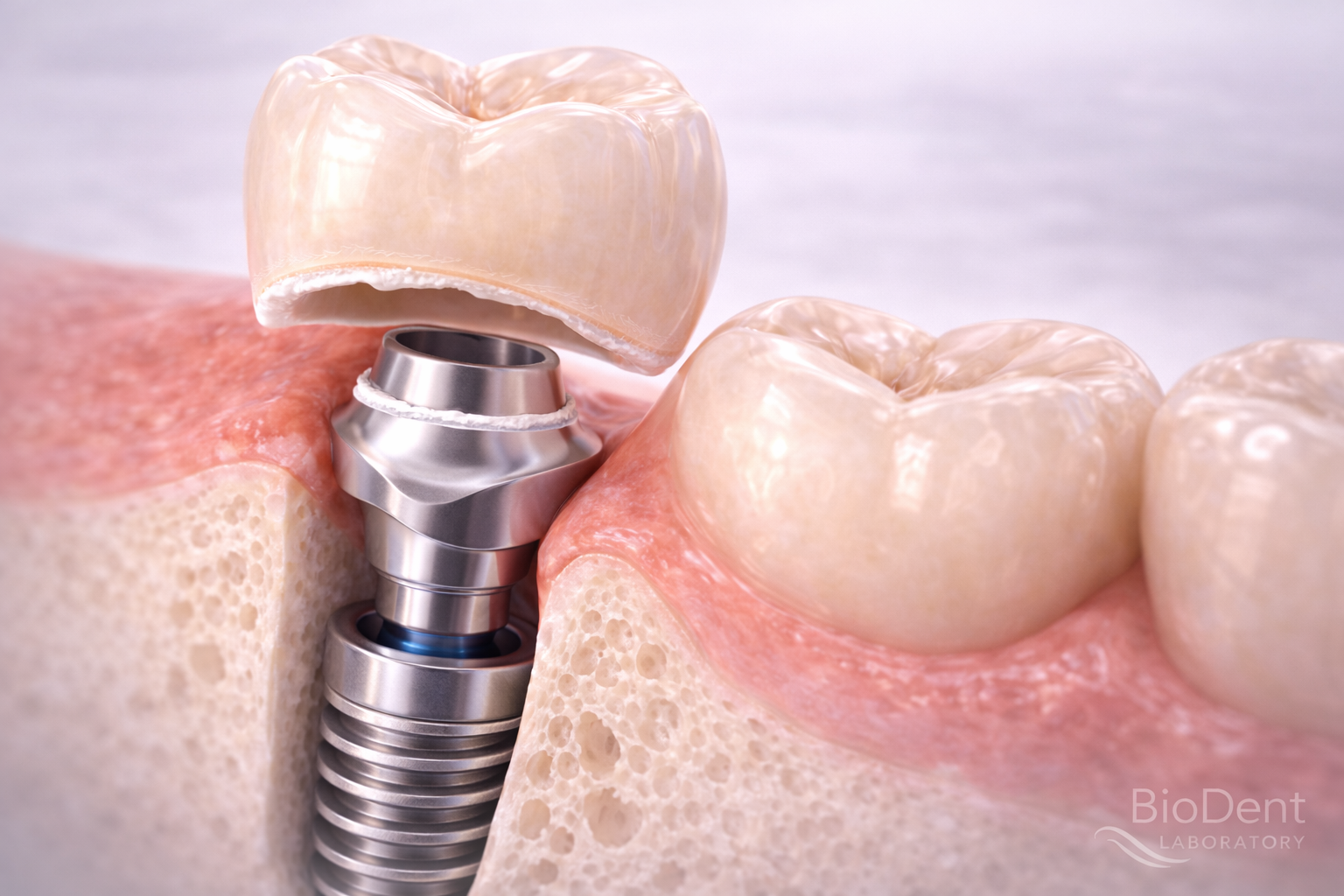
Why Cement Removal Matters So Much in Implant Dentistry
Implants and natural teeth do not react to restorative conditions in exactly the same way. Around implants, retained cement may sit below the soft tissue and still create chronic inflammation, even when the restoration initially appears clinically acceptable.
That means a crown can be fully seated, visually attractive, and still already carry a biologic risk if cement has been trapped near the margin.
Residual cement can contribute to:
- soft tissue irritation
- bleeding on probing
- plaque retention
- peri-implant mucositis
- peri-implant bone loss
- patient discomfort
- long-term restoration complications
Because of this, cement removal should be treated as a core part of implant treatment quality, not just cleanup.
Why Implant Crowns Are More Vulnerable to Cement Problems
One reason implant crowns are more vulnerable is that restorative margins are often placed subgingivally for esthetic reasons or because implant position makes the margin less accessible.
When margins sit too deep, the clinician may not be able to fully visualize all cement after crown seating. This makes complete cleanup much less predictable.
This becomes especially problematic when:
- the implant platform is positioned too deep
- soft tissue is thick
- the case is posterior and access is limited
- the crown is cement-retained
- margin planning was not handled carefully
This topic is closely connected to abutment and margin design. For more on this, see Abutment Margin Placement in Implant Restorations.
Margin Placement Directly Affects Cement Removal
The deeper the margin, the harder it becomes to remove cement thoroughly. This is why margin placement is not only a restorative issue. It is also a tissue health issue.
If margins are positioned too deep:
- cement may be pushed under the gingiva
- cleanup becomes less predictable
- visibility is reduced
- instruments have less access
- hidden cement becomes more likely
Custom abutments often help because they allow the restorative team to position margins in a more manageable and more hygienic way.
For more about this relationship, see Custom Abutment Design Principles in Modern Implant Dentistry.
Cement-Retained vs Screw-Retained Restorations
One of the clearest ways to reduce cement risk is to avoid cement when the case allows it.
Screw-retained restorations eliminate the problem of residual cement entirely. For this reason, many clinicians prefer screw retention whenever implant angulation and restorative design make it practical.
Cement-retained restorations can still be useful in selected cases, especially when esthetics or implant angle make screw access less ideal. However, the decision should always account for margin accessibility and cleanup predictability.
For a full comparison, see Screw-Retained vs Cement-Retained Restorations.
How Crown Contour Can Make Cement Removal Harder
Crown contour also influences cement removal. If the cervical third of the crown is overcontoured, instruments may have more difficulty reaching the margin.
Even when the clinician knows exactly where the margin is, bulk at the cervical zone may reduce both access and visibility. This is one reason why crown contour should always be planned not only for esthetics, but also for hygiene and maintenance.
For more on restorative form and cervical anatomy, see Implant Crown Contour and Soft Tissue Support.
Soft Tissue Health and Residual Cement
Soft tissue reacts to cement-related problems over time. In some cases, the response may appear quickly as inflammation or soreness. In others, it may progress more slowly and become visible only after tissue changes or radiographic bone loss are already present.
This is why cement control is deeply connected to soft tissue management. A restoration that cannot be cleaned well during delivery is much more likely to create biologic complications later.
For more on tissue behavior around restorations, see Soft Tissue Management Around Dental Implants.
Posterior Cases Can Be Even More Difficult
In posterior regions, cement removal may become more difficult because of:
- reduced visibility
- limited physical access
- broader crown anatomy
- thicker tissue in some cases
- more difficult patient hygiene
This means posterior cement-retained restorations should not be treated casually. Functional success alone is not enough if the margin and cement become inaccessible.
For more on posterior planning, see Implant Abutments for Posterior Restorations.
Practical Clinical Strategies to Reduce Cement Risk
Several practical strategies can reduce the chance of residual cement around implant crowns:
- plan margins where they can be visualized and cleaned
- avoid unnecessarily deep subgingival margins
- use minimal cement volume
- remove excess cement immediately and carefully
- inspect the restoration from multiple angles
- consider screw retention when appropriate
- coordinate abutment design with the lab
- avoid overcontoured cervical anatomy
These strategies work best when they are built into the restorative plan from the beginning rather than treated as last-minute corrections.
The Role of Digital Workflow in Cement Control
Digital planning can improve cement management indirectly by improving abutment design, margin location, and crown contour before fabrication.
When the restorative team plans digitally, it becomes easier to evaluate:
- where margins should sit
- how crown contour affects access
- whether screw retention is more practical
- how implant position changes cleanup difficulty
This makes digital workflow especially useful in cases where long-term tissue health and maintainability are priorities.
For more on this process, see Digital Workflow for Implant Abutments.
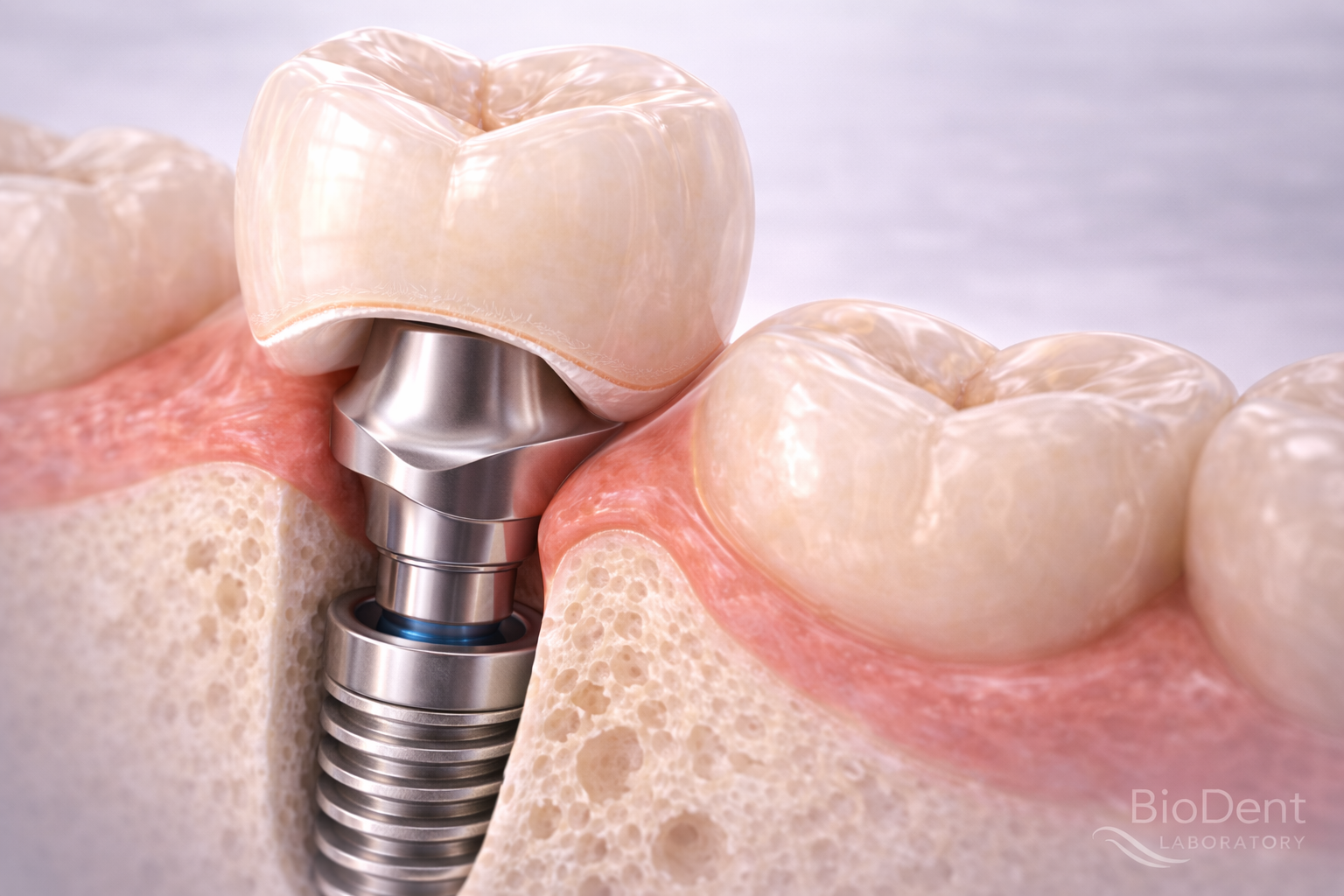
Common Cement Removal Mistakes
Some common mistakes increase cement-related risk significantly:
- using too much cement
- placing margins too deep
- assuming cement is fully removed without proper inspection
- ignoring crown contour and access limitations
- choosing cement retention without evaluating implant angle
- not coordinating margin placement with the laboratory
- prioritizing appearance without considering long-term maintenance
These errors often happen when the case is planned only for delivery day rather than for long-term clinical success.
To understand related prosthetic problems, see Common Implant Restoration Mistakes and How to Avoid Them.
Conclusion
Cement removal around implant crowns is not a minor technical detail. It is a major biologic factor in the long-term success of implant restorations.
Clinicians can reduce cement-related complications by planning margins carefully, designing cleaner contours, limiting cement volume, and selecting the most appropriate retention strategy for the case.
The more accessible and maintainable the restoration is at delivery, the more predictable its long-term tissue health becomes.
FAQ
Why is cement removal so important around implant crowns?
Because retained cement can contribute to inflammation, tissue irritation, and long-term peri-implant complications.
Are cement-retained restorations always risky?
No, but they require better margin planning, controlled cementation, and thorough cleanup.
Does deep margin placement increase cement risk?
Yes. The deeper the margin, the harder it becomes to fully remove excess cement.
Can crown contour affect cement cleanup?
Yes. Overcontoured cervical anatomy can reduce access to the margin and make cleanup more difficult.
Is screw retention safer from a cement standpoint?
Yes. Screw-retained restorations eliminate the risk of retained cement entirely.
Can digital workflow help reduce cement complications?
Yes. It can improve margin design, crown contour, and retention planning before the restoration is fabricated.
Get the Free New-Doctor Kit
Rx forms, prepaid UPS labels (both ways), our full fee schedule, and an implant-compatibility chart — shipped free, no commitment.