Stock vs Custom Abutments: Which Is Right for Implant Restorations?
Choosing the right implant abutment is one of the most important decisions in implant dentistry. In many cases, the key question is not whether the implant can be restored, but how well it can be restored, which makes the difference between stock and custom abutments clinically significant.
At first glance, both options connect the implant to the final restoration and are widely used in practice, and both can be successful when properly planned. However, they do not provide the same level of restorative control.
This page explains their clinical differences, indications, and how to select the right option based on implant position, tissue conditions, restorative goals, and long-term predictability. The main difference lies in the level of control over the final outcome, which directly affects emergence profile, tissue support, crown contour, margin placement, esthetics, and maintenance.
What Is a Stock Abutment?
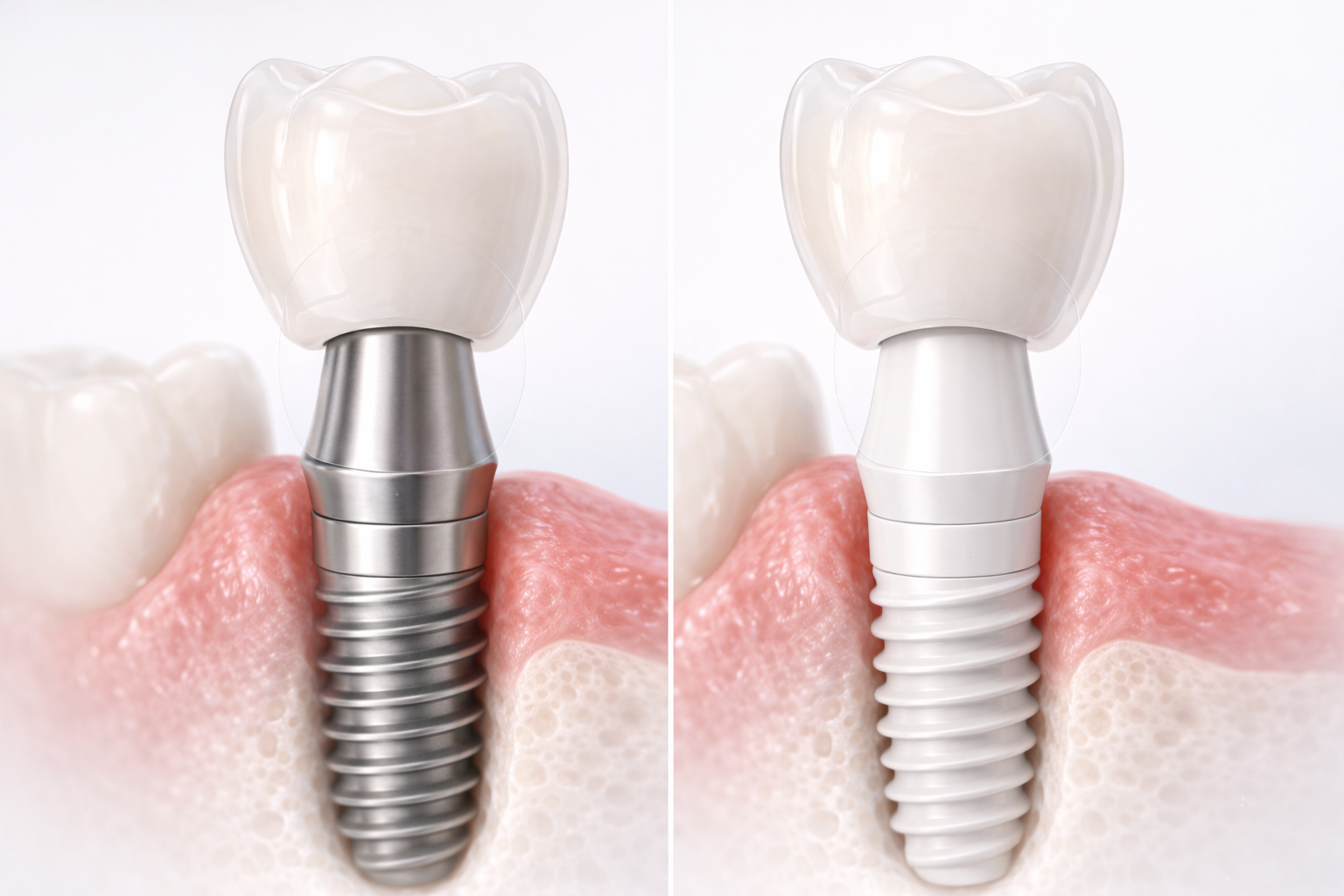
A stock abutment is a prefabricated implant component produced in standard shapes, sizes, collar heights, and angulations. It is designed to fit a given implant system, but it is not designed specifically for one patient’s tissue contour or final crown form.
Because stock abutments are manufactured in standard configurations, they are easy to access and often faster to use. This makes them attractive in straightforward restorative situations.
In many workflows, stock abutments are used because they are:
- readily available,
- familiar to clinicians,
- cost-effective,
- simple to implement,
- suitable for selected routine cases.
They can perform well when the implant position is favorable and the final restoration does not require extensive anatomical control. In many cases, limitations of prefabricated solutions become more evident when considering how implant position affects abutment choice.
What Is a Custom Abutment?
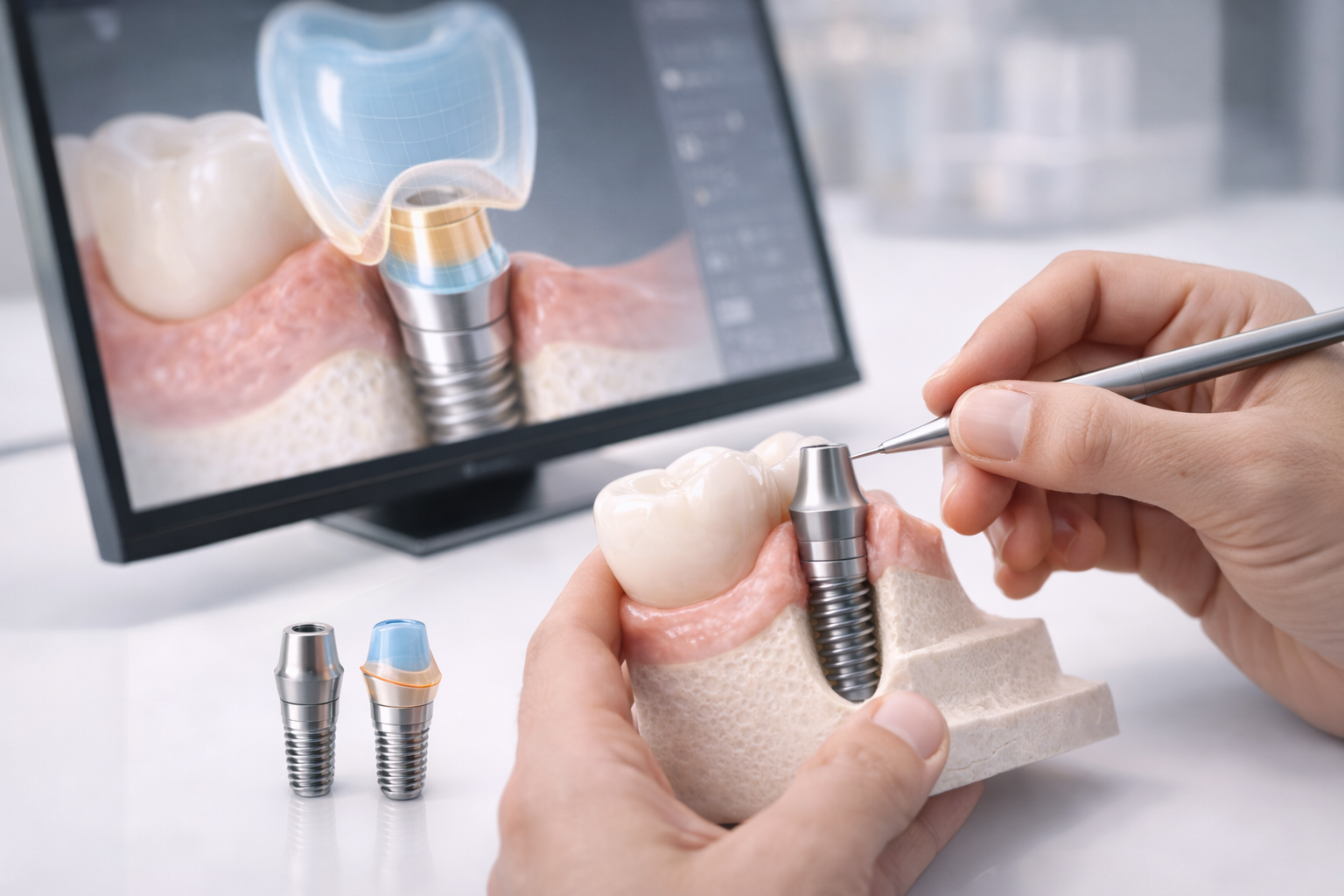
A custom abutment is designed specifically for the patient, the implant position, and the planned final restoration. It is usually developed through a digital workflow using implant scan data, soft tissue contours, and crown design requirements.
Unlike a stock abutment, a custom abutment is not limited to a generic geometry. It can be shaped to support:
- a more natural emergence profile,
- better tissue contour,
- cleaner margin placement,
- improved crown support,
- more controlled cervical form,
- restorative compensation for less-than-ideal implant position.
This makes custom abutments especially useful when the final restoration needs more precision than a standard component can easily provide. Custom solutions are often designed using the digital workflow for implant abutments, allowing for higher precision and better outcomes.
Why the Difference Matters Clinically
The stock-versus-custom decision is not a small technical preference. It changes how much restorative control the team has from the implant platform upward.
That affects several important areas:
- esthetic quality,
- crown contour,
- tissue support,
- margin accessibility,
- cement risk,
- restorative efficiency,
- amount of chairside adjustment,
- long-term maintainability.
In simple cases, the clinical difference may be moderate. In complex, visible, or tissue-sensitive cases, the difference can become significant.
This is why the decision should not be made by habit alone. It should be made by evaluating what the case actually needs. Material selection is also critical, especially when comparing titanium vs zirconia abutments.
When Stock Abutments Can Work Well
Stock abutments are often entirely acceptable when the restorative situation is favorable.
Examples include:
- posterior single-unit restorations,
- implants with ideal depth and angulation,
- thick tissue cases,
- moderate esthetic demand,
- cases with good restorative space,
- situations where the final crown shape will not be difficult to develop.
In these cases, a stock abutment may provide a practical balance of efficiency, cost, and restorative success.
When implant position is ideal, the restoration may not need extensive correction or contour control. Under those conditions, the simplicity of a stock solution can be an advantage rather than a limitation.
When Stock Abutments Become More Limiting
Stock abutments become more limiting when the restoration needs a more patient-specific transition between implant and crown.
That often happens when:
- the implant is slightly angled,
- the implant is too facial,
- the implant is placed deeper than ideal,
- the tissue profile is asymmetrical,
- the case is in the esthetic zone,
- soft tissue support matters,
- margin placement needs more control,
- the final crown would otherwise become overcontoured.
Because the stock component is generic, it may force the final restoration to compensate for what the abutment cannot do. That can make the crown bulkier, less natural, harder to clean, or more difficult to seat ideally.
This is one of the main reasons stock abutments are not always the best choice even when they seem simpler at first.
Where Custom Abutments Offer the Biggest Advantage
Custom abutments provide the strongest advantage when the case needs restorative precision rather than generic compatibility.
That includes:
- anterior restorations,
- thin tissue biotypes,
- high smile line cases,
- non-ideal implant positions,
- deeper implant platforms,
- cement-retained cases where margin placement matters,
- cases where emergence profile must be carefully shaped,
- situations where crown overcontouring must be avoided.
A custom abutment allows the restorative team to design the component around the final crown and tissue architecture instead of asking the final crown to compensate for a generic abutment.
That often leads to:
- better tissue support,
- improved esthetics,
- more natural cervical contour,
- better hygiene access,
- easier cement management,
- more predictable delivery.
Stock vs Custom and Emergence Profile
One of the clearest differences between stock and custom abutments is the emergence profile.
The emergence profile is the way the restoration rises from the implant platform through the gingiva into the visible crown form. If this area is not handled well, the restoration may look bulky, flat, artificial, or difficult to clean.
A stock abutment creates a generic transition. That may be acceptable in a simple posterior case, but it often does not match the ideal anatomy of the final tooth.
A custom abutment can be shaped to support a more anatomical emergence. This is one of the main reasons it tends to perform better in visible or esthetic cases. It helps create a smoother, more natural transition between implant and crown and often supports better soft tissue adaptation.
Stock vs Custom and Margin Placement
Margin placement is another major difference.
In cement-retained restorations, margin location matters because it directly affects cement cleanup and long-term biologic safety. If the margin is too deep, excess cement becomes harder to remove. If it is too shallow, esthetic and restorative compromises may appear.
A stock abutment offers less control here because the geometry is already predetermined. The clinician must adapt the restoration to the component.
A custom abutment makes it easier to place the margin where it is both restoratively useful and clinically manageable. This is especially valuable in tissue-sensitive and esthetic cases where biologic and visual considerations need to be balanced carefully.
Stock vs Custom in the Esthetic Zone
The esthetic zone is where custom abutments usually show their strongest value.
In anterior cases, small restorative differences become highly visible. Tissue contour, symmetry, cervical transition, and crown emergence all matter more. A generic component may not support the level of precision needed for a highly natural outcome.
In these cases, a custom abutment often helps by:
- improving soft tissue support,
- reducing cervical bulk,
- creating a more natural emergence profile,
- controlling the relationship between crown and gingiva,
- supporting a more refined final restoration.
A stock abutment can still work in some anterior cases if implant position is excellent and tissue is favorable, but the margin for error is smaller. The more visible and demanding the case is, the more custom design tends to make sense. In esthetic zones, achieving natural results depends heavily on proper implant crown contour and soft tissue support.
Stock vs Custom in Posterior Cases
Posterior cases often reduce esthetic pressure and place more emphasis on function, efficiency, and load management.
Because of that, stock abutments may remain very reasonable in many posterior single-unit restorations, especially when:
- implant position is favorable,
- tissue thickness is sufficient,
- occlusal space is adequate,
- the restoration does not require complex contour correction.
Custom abutments can still be useful in posterior cases, particularly when implant position is not ideal or when crown form and margin control still require more precision. But in many routine posterior situations, the difference between stock and custom may be less dramatic than in the anterior zone. The final outcome is also influenced by the implant emergence profile, which determines soft tissue adaptation.
Implant Position Often Decides the Answer
Implant position is one of the most important factors in the stock-versus-custom decision.
A stock abutment becomes more reasonable when:
- depth is favorable,
- angle is favorable,
- facial-lingual position is favorable,
- restorative space is adequate,
- crown contour will be straightforward.
A custom abutment becomes more useful when:
- the implant is not ideally positioned,
- angulation creates restorative compromise,
- the implant sits too deep,
- the implant is too facial,
- emergence profile requires more control,
- the crown would otherwise need excessive contour.
This is why stock versus custom should not be discussed in isolation. It is often implant position that determines how much restorative adaptation the abutment needs to provide.
Digital Workflow and Custom Abutment Planning
Digital dentistry has made custom abutments much more practical and more predictable than in older workflows.
A modern digital process may include:
- intraoral scan,
- scan body registration,
- digital implant library use,
- soft tissue evaluation,
- crown-driven planning,
- CAD design,
- custom emergence shaping,
- CAD/CAM milling.
This allows the abutment to be designed around the intended final restoration rather than chosen from a generic set of shapes.
As a result, custom abutments are now easier to integrate into everyday restorative workflows, especially for practices already sending digital cases to the lab.
This does not make stock abutments obsolete. But it does mean the barrier to using custom abutments in the right cases is much lower than it used to be.
Workflow, Time, and Cost Considerations
One reason stock abutments remain common is that they usually feel simpler and more economical upfront. They are easier to order, faster to access, and more familiar in routine workflows.
Custom abutments usually involve:
- more planning,
- design time,
- manufacturing time,
- more case-specific communication,
- a higher direct cost.
However, that does not always mean the total restorative cost is truly lower with stock components. If a stock abutment leads to more chairside correction, less ideal contour, more difficult cement management, or esthetic compromise, the “simpler” option may not always be the most efficient one overall.
The choice of abutment is closely related to the restorative approach, particularly when comparing screw-retained vs cement-retained restorations. In many cases, the real question is not which option is cheaper at the component level, but which option produces the better restorative process and more predictable final outcome.
Common Mistakes in the Stock vs Custom Decision
A common mistake is using stock abutments by default in every case without asking whether the restoration would benefit from greater control.
Another mistake is assuming that custom abutments are only for high-end cosmetic cases. In reality, they can also be highly useful in non-esthetic cases where implant position, margin control, or restorative space creates practical challenges.
Other frequent mistakes include:
- ignoring emergence profile,
- overlooking implant depth and angulation,
- separating abutment choice from crown design,
- choosing based only on initial cost,
- underestimating how soft tissue will affect the final restoration.
The best decision usually comes from evaluating the case, not repeating the same component choice every time.
A Practical Way to Think About the Choice
A useful first question is this: does this case require a generic solution, or does it require restorative customization?
If the case is simple, posterior, well-positioned, and low-risk from a contour and tissue perspective, a stock abutment may be fully appropriate.
If the case is visible, tissue-sensitive, position-sensitive, or contour-sensitive, a custom abutment often becomes the more strategic option.
Then evaluate:
- implant position,
- tissue thickness,
- esthetic demand,
- restorative space,
- retention type,
- margin control needs,
- hygiene access,
- long-term maintenance expectations.
The right decision is not based on theory alone. It is based on what the restoration needs to succeed cleanly and predictably.
Conclusion
Stock and custom abutments can both work successfully, but they do not offer the same level of restorative control.
Stock abutments remain practical and efficient in many straightforward cases, especially when implant position and tissue conditions are favorable. Custom abutments become increasingly valuable when the case requires better emergence profile, better tissue support, more controlled margins, and a more refined final restoration.
The better option is not the one that sounds more advanced. It is the one that fits the restorative demands of the case most accurately.
FAQ
What is the main difference between stock and custom abutments?
The main difference is that stock abutments are prefabricated in standard shapes, while custom abutments are designed specifically for the patient, implant position, and final restoration.
Are custom abutments always better than stock abutments?
No. Custom abutments provide more control, but stock abutments can work very well in simple, well-positioned, lower-demand cases.
When does a custom abutment usually make more sense?
A custom abutment usually makes more sense in esthetic cases, thin tissue cases, non-ideal implant positions, and situations where emergence profile or margin control is important.
Can stock abutments work in anterior cases?
Sometimes yes, but only when implant position, tissue conditions, and esthetic demands are especially favorable.
Why do custom abutments help with cement-retained restorations?
They help because they allow better control over margin placement, which can make cement cleanup easier and reduce restorative compromise.
Does digital workflow make custom abutments easier to use?
Yes. Digital workflow allows more precise design, better communication, and easier integration of custom abutments into modern implant restorative planning.
Resources & References
- American Academy of Implant Dentistry
- ITI — International Team for Implantology
- Journal of Oral Implantology (PubMed)
Get the Free New-Doctor Kit
Rx forms, prepaid UPS labels (both ways), our full fee schedule, and an implant-compatibility chart — shipped free, no commitment.