How Implant Position Affects Abutment Choice in Implant Restorations
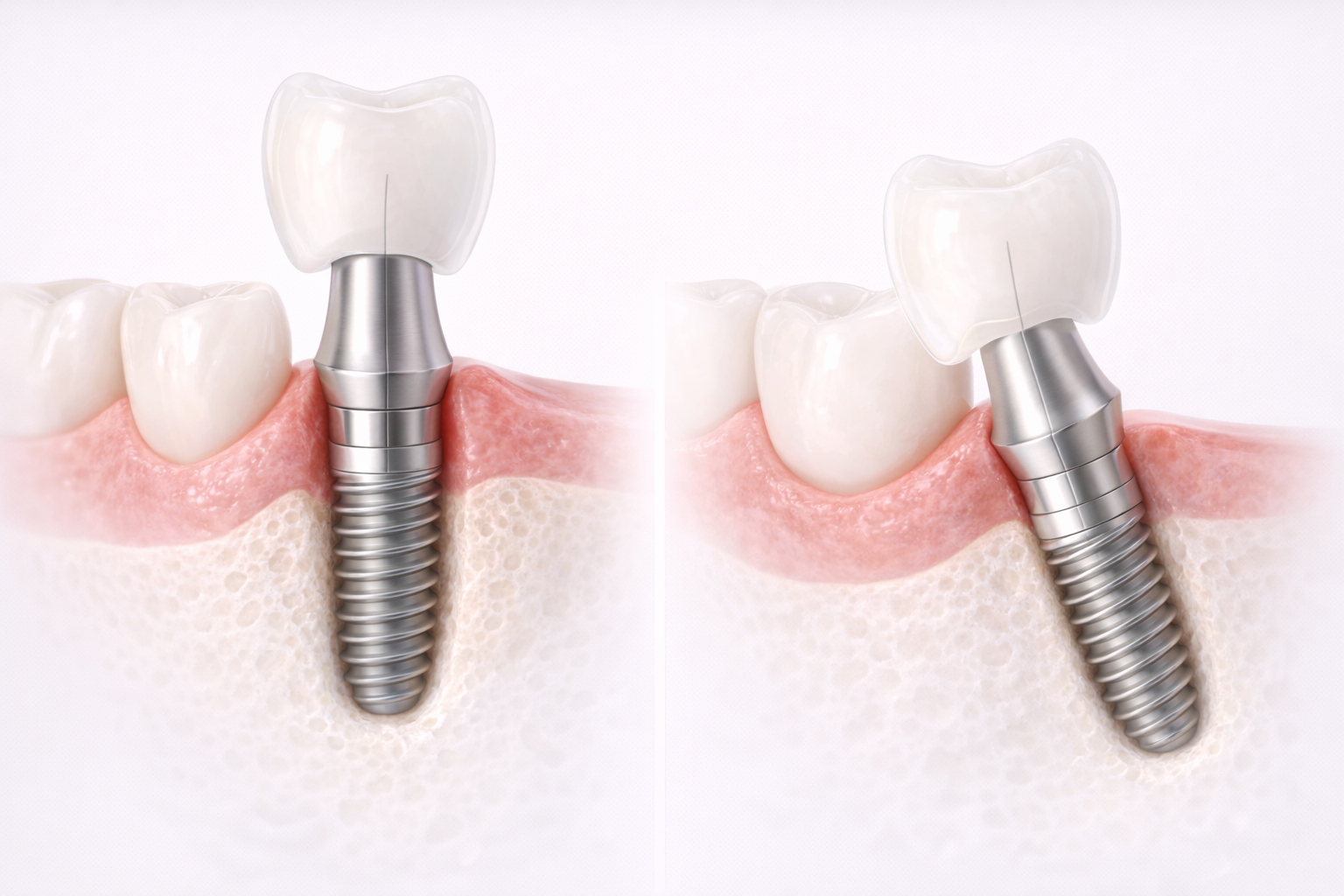
Implant restorations are not determined by the implant alone. The final result depends on how the implant is positioned in relation to the future crown, the surrounding soft tissue, the occlusal forces, and the restorative space available. One of the most important consequences of implant position is abutment selection.
In simple cases, implant placement allows the dentist and the lab to work with straightforward restorative options. In more demanding cases, the position of the implant changes everything. A slightly facial implant, a deeper platform, limited restorative space, or an unfavorable angle can all influence whether a stock abutment is still reasonable or whether a custom solution becomes the better choice.
This page explains the real clinical differences between titanium and zirconia abutments, including strength, esthetics, tissue behavior, restorative indications, limitations, and how to choose the right option for different implant situations. Before choosing between titanium and zirconia, it’s important to understand the role of dental implant abutments in modern implant restorations.
Why Implant Position Matters So Much
A dental implant may integrate successfully and still create restorative limitations if its position is not ideal for the final prosthetic design. This is one of the most important realities in implant dentistry. Surgical success does not automatically mean restorative simplicity.
Implant position affects:
- the path of insertion,
- the shape of the final crown,
- the emergence profile,
- margin placement,
- soft tissue support,
- screw access location,
- retrievability,
- hygiene access,
- long-term esthetics.
Because of this, abutment selection should never be treated as a separate decision made after everything else is already fixed. The abutment is the component that often compensates for or adapts to implant position. In ideal cases, that compensation is minimal. In less ideal cases, it becomes central to the restorative strategy.
The Relationship Between Implant Position and Abutment Choice
Abutment selection depends heavily on how favorable or unfavorable the implant position is for the intended restoration.
When the implant is placed ideally, the restorative team may have more freedom to use a simpler solution. A stock abutment may be clinically acceptable, margins may be easier to manage, and crown contour may stay natural without excessive modification.
When implant position is less favorable, the abutment often needs to do more work. It may need to:
- correct or soften the impact of implant angulation,
- improve emergence profile,
- reposition margins,
- support soft tissue more precisely,
- reduce overcontouring,
- make a cement-retained design more manageable,
- improve the path and esthetics of the final restoration.
This is why implant position and abutment selection are closely tied together. One directly influences the other.
Implant Depth and Abutment Selection
Implant depth is one of the first factors that can change restorative planning. If the implant platform is positioned too deep, the abutment and final crown may be forced into a more difficult relationship with the soft tissue.
A deeper implant can create several restorative challenges:
- margins may end up too subgingival,
- cement removal may become more difficult,
- the crown may become too long cervically,
- the emergence profile may become too abrupt,
- soft tissue adaptation may become harder to control.
In such cases, a custom abutment often becomes more useful because it allows better control over margin location and transmucosal shape. Instead of accepting a generic component and forcing the crown to compensate, the restorative team can design the abutment to create a more favorable transition.
If the implant depth is ideal, a stock abutment may still be reasonable in selected cases. But when depth begins to complicate the restorative zone, custom design usually becomes more valuable.
Implant Angulation and Abutment Choice
Implant angulation is another major factor. Even a slight deviation can affect how the final restoration must be designed.
If the implant is ideally aligned with the intended crown, restorative planning becomes simpler. The screw path may be more favorable, emergence may look more natural, and stock components may work in some situations.
When angulation is off, the restorative team may face:
- facial screw access,
- compromised crown contour,
- esthetic limitations,
- more difficult seating,
- overcontoured restoration design,
- less ideal force direction.
This is where the choice between straight, angled, stock, and custom abutments becomes more important. A custom abutment may allow the restorative team to recover some control and create a cleaner result. In screw-retained cases, implant angulation becomes especially important because it directly affects where the screw access emerges.
If angulation is severely unfavorable, the abutment alone cannot fully solve the problem. But in many mild to moderate cases, the right abutment design can significantly improve the restorative outcome.
Facial-Lingual Implant Position
The facial-lingual position of the implant often has a major esthetic impact, especially in anterior cases.
If the implant is too facial, the final restoration may be difficult to manage. The crown may need to be overcontoured, the tissue may appear less natural, and the cervical emergence may become bulky or unstable.
If the implant is too palatal or too lingual, the restoration may become functionally awkward or require compensation in the crown form. This may also influence screw access direction, crown emergence, and lab design decisions.
When the facial-lingual position is ideal, the restorative team can create a more natural emergence profile with fewer compromises. When it is not ideal, custom abutments often become more important because they allow more precise management of contour and tissue transition.
This is one of the main reasons custom abutments are so often recommended in esthetic cases. They help the clinician and lab work around position-related limitations more precisely than stock components usually allow.
Mesio-Distal Implant Position
Mesio-distal placement also affects abutment planning, even though it is sometimes discussed less than depth or angulation.
If the implant is positioned too close to adjacent teeth or too far from the ideal center of the restorative space, the final crown shape can become compromised. Contact points, papilla support, and crown symmetry may all be affected.
From an abutment perspective, mesio-distal limitations may influence:
- how the crown emerges,
- how contact areas are developed,
- how soft tissue is supported interproximally,
- how natural the final proportions appear.
When interproximal support is critical, especially in the anterior zone, custom abutment design may help improve tissue support and create a more refined restorative form. In the anterior zone, achieving natural esthetics depends heavily on proper crown contour and soft tissue support, especially when working with zirconia abutments. A stock abutment may be less capable of adapting to these subtleties.
Restorative Space and Abutment Design
Restorative space is often underestimated, but it can strongly influence abutment choice. Even if the implant position is acceptable, limited vertical or horizontal space can narrow restorative options.
When space is limited, the abutment must work within tighter constraints. Material choice, crown thickness, retention design, and margin location all become more sensitive.
Limited restorative space may lead to:
- reduced material thickness,
- less ideal crown form,
- restricted abutment geometry,
- harder seating and finishing,
- more need for precise CAD/CAM design.
In these cases, custom abutments can offer an advantage because they can be designed specifically around the available space. Stock abutments may force the restorative team into compromises that make the crown less ideal.
How Implant Position Affects Stock vs Custom Abutment Decisions
Implant position is one of the clearest reasons why some cases can tolerate a stock abutment and others cannot.
A stock abutment may still be reasonable when:
- implant depth is favorable,
- angulation is favorable,
- facial-lingual position is favorable,
- the case is posterior,
- tissue conditions are simple,
- esthetic expectations are moderate,
- restorative space is adequate.
A custom abutment becomes more useful when:
- implant depth creates margin challenges,
- implant angulation affects crown direction,
- the implant is too facial or slightly off position,
- the case is esthetic-sensitive,
- tissue support must be controlled carefully,
- restorative space is limited,
- crown contour would otherwise be compromised.
This is not because stock abutments are automatically inferior. It is because implant position determines how much restorative adaptation is required. The more adaptation the case needs, the more valuable custom design becomes.
When Implant Position Pushes the Case Toward a Custom Abutment
There are several situations where implant position strongly suggests that a custom abutment is the better restorative choice.
These include:
- anterior single-unit restorations with high esthetic demand,
- implants placed slightly facially,
- deeper implant platforms,
- limited restorative space,
- mild to moderate angulation issues,
- asymmetrical tissue contour,
- cement-retained cases needing cleaner margin control,
- cases where overcontouring would otherwise be likely.
In these situations, custom abutments often help improve the relationship between implant platform and final crown form. That usually leads to a more natural emergence profile, cleaner contours, and a more maintainable restoration.
Implant Position and Soft Tissue Management
Soft tissue is often where implant position problems become visible. Even when the implant is fully integrated, tissue contour may reveal restorative compromises if the implant platform is not ideally located.
When implant position is favorable, the abutment can support a natural transition from implant to crown. Soft tissue tends to look more stable and symmetrical, and the final restoration is often easier to clean.
When implant position is less ideal, soft tissue may become harder to manage. The crown may need to compensate, and the abutment may need to provide more intentional support for tissue contour.
This is especially important in:
- thin tissue biotypes,
- high smile lines,
- anterior central incisors,
- cases with visible gingival architecture,
- cases with asymmetrical soft tissue.
In patients with a thin gingival biotype, the implant emergence profile becomes critical for preventing gray shine-through and achieving natural-looking results. A custom abutment is often better suited for these tissue-sensitive cases because it gives the restorative team more control over the emergence zone.
Screw-Retained vs Cement-Retained Implications
Implant position also affects whether a screw-retained or cement-retained approach is more practical.
If implant angulation allows a favorable screw access path, a screw-retained solution may be preferred for retrievability and maintenance. But if the angulation pushes the access hole into an esthetically undesirable location, the restorative design becomes more difficult.
In those cases, a cement-retained restoration may be considered. But then abutment design becomes even more important, because the margins need to be placed in a way that still allows cement cleanup.
This means implant position does not only affect abutment type. It also influences the entire retention strategy of the case. A deeper or more angled implant often increases the importance of custom abutment planning.
How the Lab Uses Implant Position Information
The lab can only design the right abutment when the case information reflects the real implant position clearly. This is why communication between clinic and lab matters so much in implant prosthetics.
For better abutment planning, the lab should ideally receive:
- an accurate digital scan or impression,
- implant system information,
- scan body data,
- tissue photos,
- occlusal information,
- shade goals,
- retention preference,
- notes about esthetic priorities,
- restorative concerns related to implant placement.
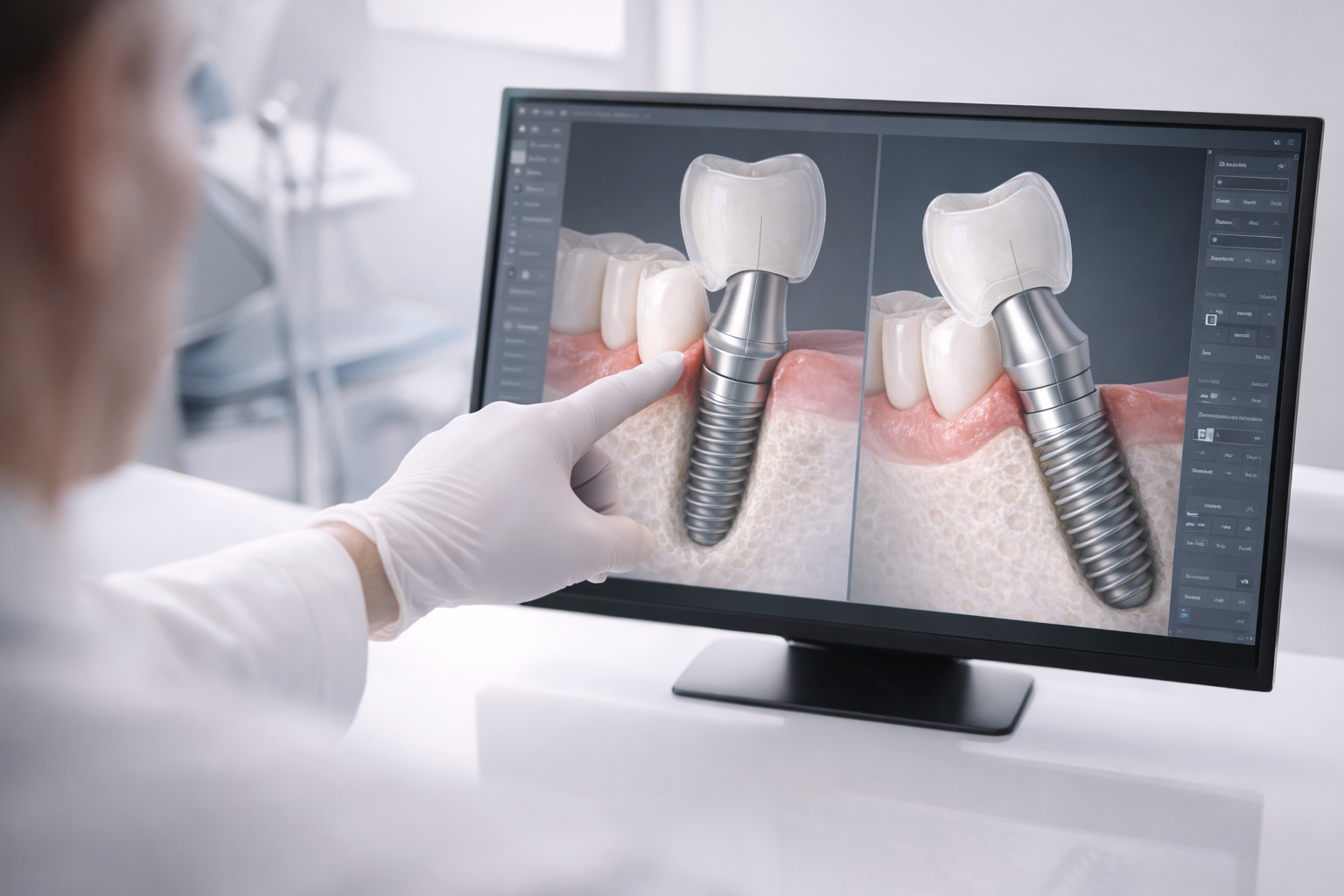
The better the data, the easier it is for the lab to design around implant position rather than guessing within it. In digitally planned cases, this becomes even more powerful because the abutment can be designed around the final crown form with more accuracy. Today, material selection is increasingly influenced by the digital workflow, allowing for more precise customization of both titanium and zirconia abutments.
Common Mistakes When Implant Position Is Not Considered Properly
A common mistake is choosing the abutment before fully evaluating how implant position affects the final restoration. This often leads to a crown that must compensate for a component choice that was never ideal.
Another mistake is assuming that a surgically successful implant automatically creates a simple restorative case. Many restorative limitations only become clear later, when the crown contour and tissue relationship are being finalized.
Other frequent mistakes include:
- using stock components by default,
- underestimating how facial positioning affects emergence,
- ignoring how implant depth affects cement cleanup,
- failing to communicate position-related concerns to the lab,
- selecting retention type before assessing screw access feasibility.
In many of these cases, the real issue is not the implant alone. It is the lack of restorative planning around the implant position.
A Practical Way to Think About It
A simple way to approach abutment selection is to ask this question first: does the implant position support a straightforward restoration, or does it require restorative compensation?
If the implant position is favorable, the case may tolerate a simpler abutment decision.
If the implant position introduces restorative challenges, the abutment should be selected more strategically.
That means evaluating:
- depth,
- angle,
- facial-lingual placement,
- mesio-distal spacing,
- restorative space,
- soft tissue profile,
- retention strategy,
- esthetic expectations.
The more the implant position challenges the final restoration, the more the abutment becomes a design tool rather than just a component.
Conclusion
Implant position has a direct effect on abutment choice because it shapes the restorative possibilities of the case. Depth, angulation, facial-lingual placement, mesio-distal spacing, and restorative space all influence whether the final crown can be simple and natural or whether it will require more design control.
When implant position is favorable, restorative planning is often more flexible. When implant position is less ideal, abutment selection becomes more critical. In many of those cases, a custom abutment helps the dentist and lab regain control over emergence profile, margin placement, contour, and tissue support.
The best abutment choice is rarely made in isolation. It should always be made in response to implant position and the restorative demands that position creates.
FAQ
Why does implant position affect abutment choice?
Implant position affects crown contour, margin location, soft tissue support, screw access direction, and restorative space. Because of that, it directly influences which abutment design will work best.
Can a stock abutment still work if the implant position is not perfect?
Sometimes yes, but only in selected cases. The more the implant position creates restorative challenges, the more useful a custom abutment usually becomes.
Which implant position problem most often increases the need for a custom abutment?
Facial positioning, excessive depth, and unfavorable angulation are among the most common reasons a custom abutment becomes more valuable.
Does implant depth affect cement-retained restorations?
Yes. If the implant is too deep, crown margins may become too subgingival, which can make cement cleanup more difficult and increase biologic risk.
Why is facial implant position such an esthetic problem?
A facial implant often pushes the restoration toward overcontouring and can compromise emergence profile, tissue appearance, and natural crown form.
How can the lab help when implant position is less ideal?
The lab can design a more precise custom abutment if it receives accurate scans, implant system details, photos, and clear restorative goals from the clinic.