How to Choose a Dental Lab: 7 Questions That Separate Good Labs from Great Ones
The dental laboratory you work with shapes the quality of every restoration you deliver. It affects your chair time, your remake rate, your patient outcomes, and ultimately your reputation as a clinician.
Yet most dentists choose a lab based on price, proximity, or whoever called them first. These are not the right criteria — and practices that choose this way tend to cycle through labs every few years, absorbing the disruption and cost each time.
This guide gives you a structured framework for evaluating any dental laboratory, whether you are choosing your first or reconsidering your current one.
Why Your Lab Choice Matters More Than Most Dentists Realize
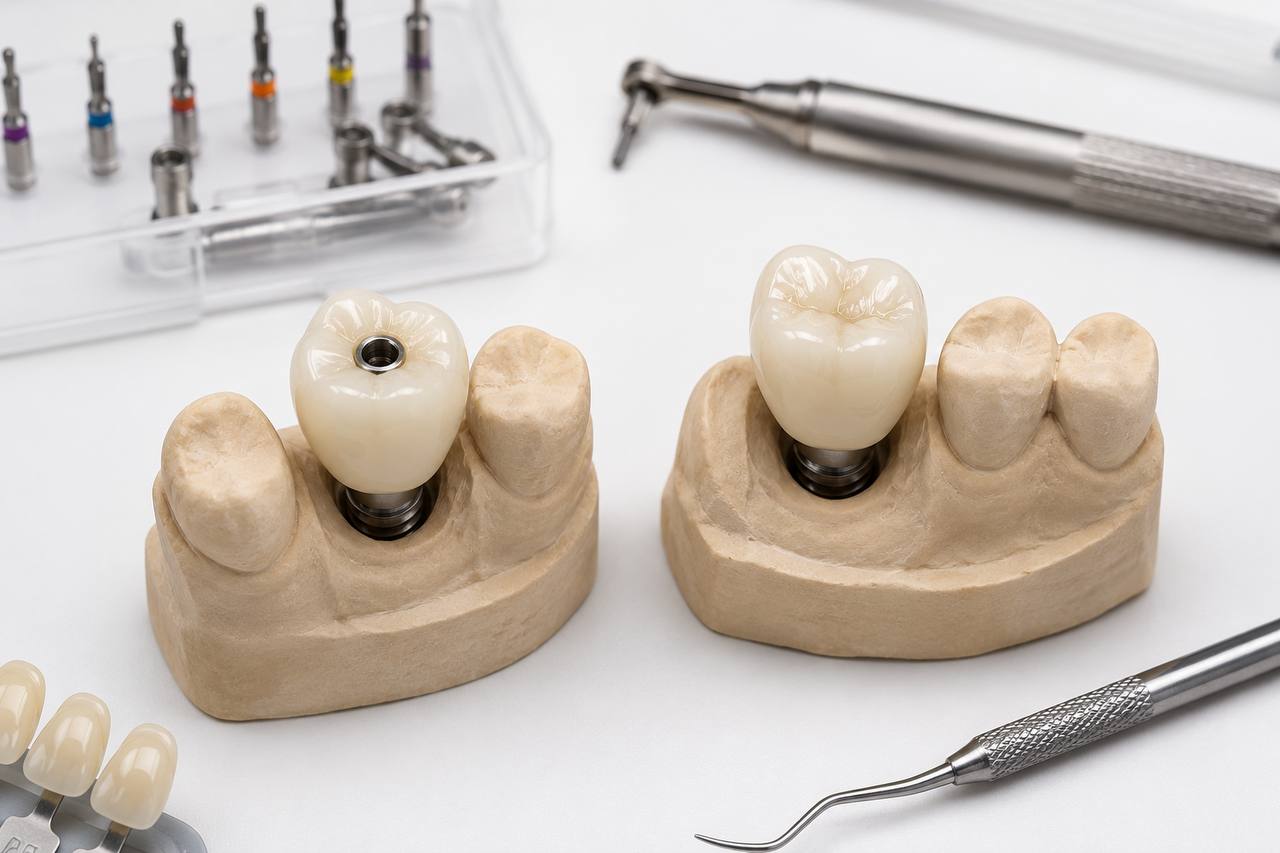
A restoration that comes back fitting poorly costs you time in adjustments, chair time you did not schedule, and — if the patient notices — confidence in your work. A lab that communicates poorly forces you to over-specify every case just to avoid errors. A lab with slow turnaround constrains your scheduling flexibility and extends patient wait times.
On the other side, a strong lab relationship makes you a better clinician. When your technician understands your preferences, knows your patient population, and flags potential issues before fabrication rather than after, you make better clinical decisions with less effort.
The questions below are designed to surface the difference between a lab that can technically produce your case and one that will actively support the quality of your practice.
Question 1: What Materials Do You Work With — and Do You Use Them In-House?
This is the first and most important question, and the follow-up matters as much as the initial answer.
Many laboratories claim to offer a full range of materials but outsource specific work — sending zirconia milling to a third-party mill, for example, or subcontracting implant framework work. There is nothing inherently wrong with outsourcing, but you should know when it is happening and how it affects your turnaround, quality control, and communication chain.
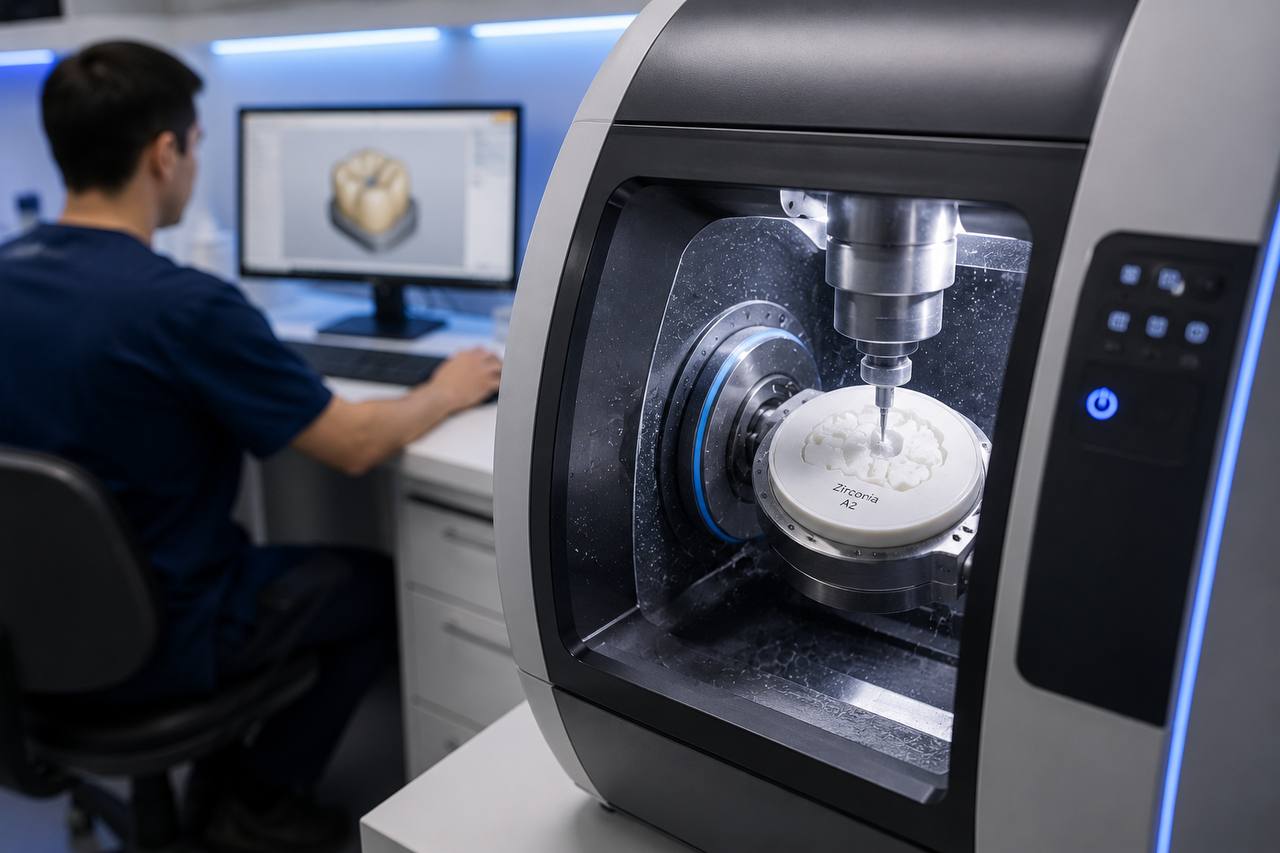
A lab that mills zirconia in-house has direct control over the CAD design, milling tolerances, sintering parameters, and finishing. A lab that outsources milling is dependent on a third party for a significant portion of the fabrication process.
Ask specifically: Do you mill zirconia in-house? Do you press e.max in-house? For implant cases, do you fabricate the custom abutments yourselves?
BioDent mills zirconia and fabricates custom implant components in-house at our Matawan, NJ facility. When you send a case to BioDent, every stage of fabrication happens under one roof.
Question 2: What Is Your Average Turnaround Time — by Case Type?
Turnaround time is not a single number. A lab that tells you “five days” without qualifying that statement is giving you an incomplete answer.
A single-unit zirconia crown and a full-arch implant bridge are not the same case.
Digital cases that arrive as scans process differently than traditional impressions that need to be poured and mounted. Rush cases handled the same day as standard cases affect both.
Ask for turnaround by case type: single-unit crown, multi-unit bridge, implant crown, complete denture, partial denture, reline. Then ask what happens when a case arrives incomplete — missing information, poor impression quality, unclear instructions. Does the lab hold the case and contact you, or does it proceed and hope for the best?
A lab that holds incomplete cases and calls you immediately is protecting your outcome. A lab that proceeds with assumptions is optimizing for its own throughput at the expense of your result.
Question 3: How Do You Handle Remakes?
Every laboratory has remakes. The question is not whether they happen — it is how the lab responds when they do.
A lab with a straightforward remake policy — no-charge remakes for laboratory error, clear documentation of what constitutes a laboratory error versus a clinical error, and fast turnaround on the replacement — is a lab that stands behind its work.
A lab that disputes responsibility for every remake, charges for cases where the error is genuinely on their side, or turns remakes around at the same speed as regular cases is a lab that does not prioritize your relationship.
Ask directly: What is your remake policy? How do you distinguish between a lab error and a clinical error? What is your turnaround for remakes?
Also ask what their remake rate is. A well-run laboratory tracks this number and should be able to give you a general figure. A high remake rate is a quality control signal. A lab that does not track it is not measuring what matters.
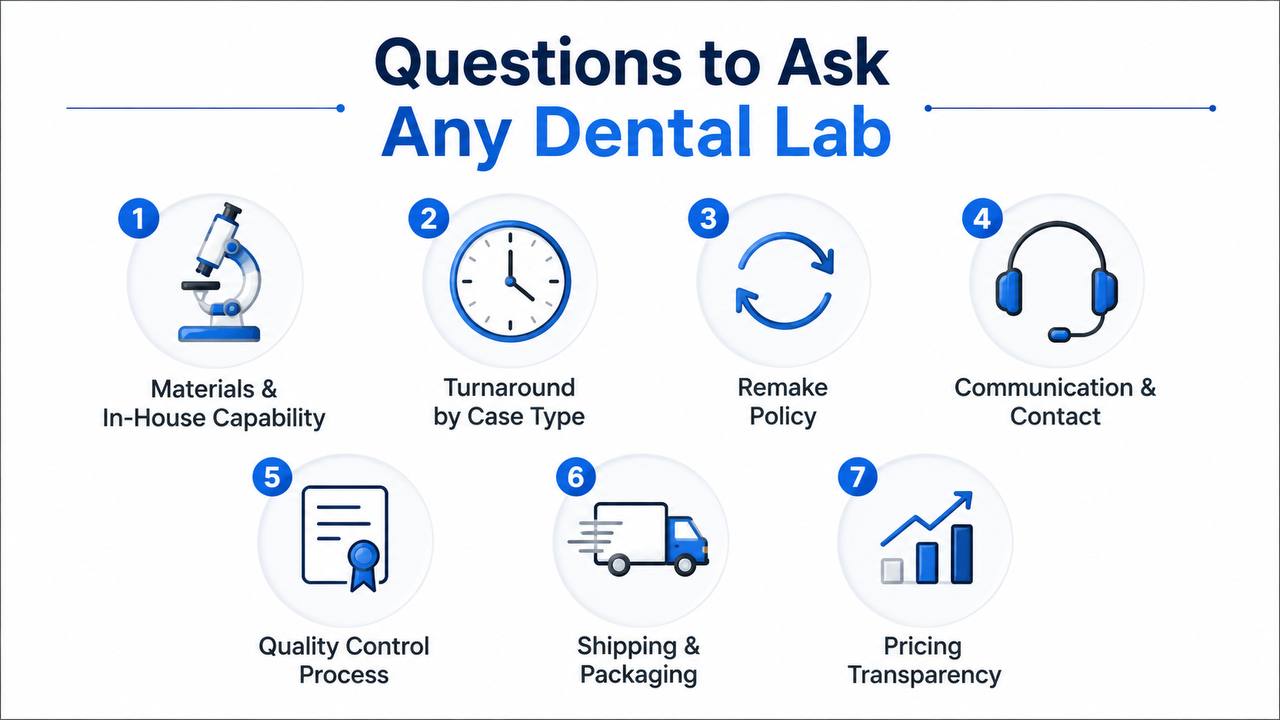
Question 4: Who Do I Actually Talk to When There Is a Question on a Case?
Communication structure matters more than most dentists anticipate until they experience a breakdown.
Some laboratories route all case communication through a customer service team with no direct access to the technicians fabricating the work. You submit a question, it goes to a representative, it gets relayed to the lab floor, and the answer comes back hours later — often incomplete, often generic.
Other laboratories give you direct access to the technician working your case, or at minimum to a case manager with genuine technical knowledge who can answer clinical questions, discuss shade, and flag concerns before fabrication rather than after.
Ask: If I have a question about a case in production, who do I contact? Is there a direct line to the technician or a case manager with technical expertise? What is the expected response time?
This question also reveals something about how the laboratory is organized. A lab that treats communication as a workflow priority is a lab that has thought carefully about the dentist-technician relationship.
Question 5: How Do You Ensure Consistent Quality Across Cases?
Consistency is the most underrated quality in a dental laboratory. A lab that produces one exceptional case and one mediocre case is less valuable than a lab that delivers solid, predictable results every time.
Ask about quality control process: Is there a final check before cases ship? Who performs it? What do they look for? Is it the same technician who fabricated the case, or an independent review?
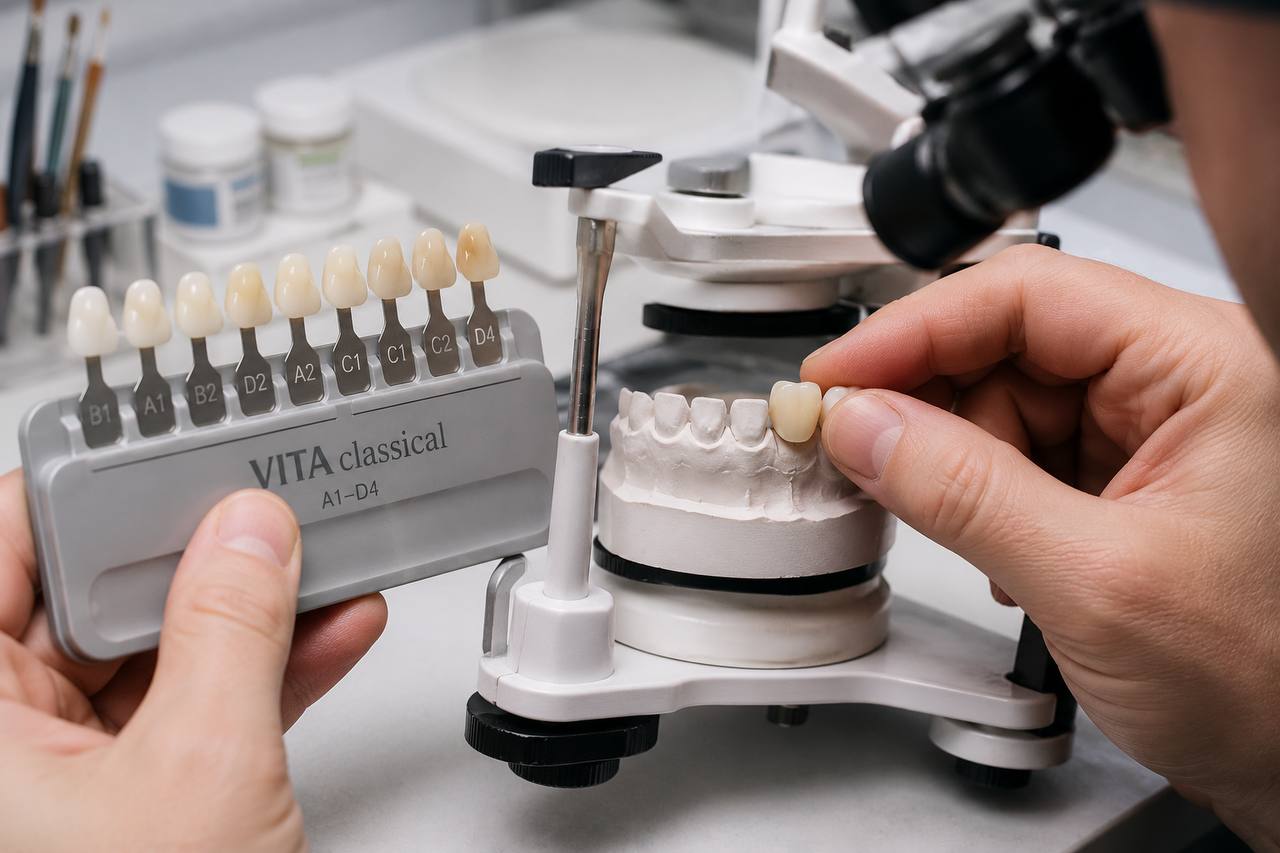
Ask about shade matching specifically — it is the most subjective step in the process and the most common source of dissatisfaction.
Does the lab use a standardized shade matching protocol? Do they photograph and document shade decisions? What happens if the shade is off on delivery?
A laboratory that cannot describe its quality control process in specific terms probably does not have a systematic one.
Question 6: How Do You Handle Digital Cases and What Scanning Systems Do You Accept?
Digital dentistry is not the future — it is the present workflow for most restorative practices. If your laboratory cannot seamlessly receive and process digital cases, you are either holding back your own workflow or absorbing extra steps to compensate.
Ask which intraoral scanner formats the lab accepts. Major systems — iTero, 3Shape TRIOS, Carestream, Planmeca — should all be supported. Ask whether the lab has its own in-house scanner for cases that arrive as traditional impressions, and how they handle the transition between analog and digital workflow.
Also ask about communication on digital cases specifically. Can you submit a scan and get a digital approval of the proposed design before fabrication begins? Design approval gives you the opportunity to review the proposed crown shape, contact points, and occlusion before the case is milled — catching problems at a stage where they are easy to fix.
BioDent accepts all major scanner formats and offers digital design approval on request for complex or esthetic cases.
Question 7: What Does Your Pricing Actually Include?
Lab pricing is rarely as simple as the price list suggests. Understanding what is and is not included prevents surprises on your invoice and allows you to make an accurate cost comparison between laboratories.
Ask whether the base price includes try-in appointments and adjustments. Ask whether rush fees apply automatically to certain case types or only on request. Ask how remakes are invoiced when fault is disputed. Ask whether custom shade work, staining, or characterization carries an additional charge.
Pricing transparency is also a proxy for how the laboratory operates overall. A lab that is clear and specific about what you are paying for is a lab that is organized and confident in its value. A lab that is vague or inconsistent on pricing questions is often vague and inconsistent in other areas as well.
One More Thing: Trial Cases Tell You More Than Sales Calls
Every laboratory will tell you what you want to hear during a sales conversation. The only way to actually evaluate a laboratory is to send cases and observe how they perform across the full workflow — case receipt, communication, fabrication quality, turnaround, delivery, and response to problems.
Start with a trial period of five to ten cases across a range of case types. Pay attention not just to the physical result but to every touchpoint: how quickly they acknowledged receipt, how proactively they communicated questions, how the case was packaged, how they responded when something needed adjustment.
A laboratory earns a long-term relationship through consistent performance across dozens of cases, not through a compelling initial impression.
Frequently Asked Questions
How many dental labs should I evaluate before choosing?
Two to three is enough for a meaningful comparison. Evaluating more than three simultaneously makes it difficult to track performance consistently.
Start with your top candidates based on the questions above, run a trial period with each, and make your decision based on actual case performance.
Should I use one lab for everything or different labs for different case types?
One primary laboratory with a strong relationship across case types is preferable. It simplifies communication, builds shared context over time, and gives the lab enough volume to prioritize your cases. Using multiple labs for different case types works but increases administrative complexity and reduces the depth of any single relationship.
How do I know if my current lab is good enough?
Track your remake rate, adjustment time at delivery, and patient-reported issues over a quarter. If your remake rate is above three to five percent, if you are regularly spending significant chair time adjusting restorations, or if patients are commenting on shade or fit, your laboratory is contributing to the problem.
Does BioDent work with practices outside New Jersey?
Yes. BioDent serves dental practices across the United States. Cases are shipped and received via standard carriers, and turnaround times reflect total time from case receipt to dispatch, not including transit.
Why Dentists Choose BioDent
BioDent Laboratory is based in Matawan, New Jersey, and has been producing precision dental restorations for practices across the United States for over twenty years. We mill zirconia and fabricate implant components in-house, accept all major digital scan formats, and provide direct case communication with a team that has genuine technical knowledge.
We offer a straightforward remake policy, transparent pricing, and same-day service for eligible urgent cases.
Also relevant: How to Send Cases to a Dental Lab · Screw-Retained vs. Cement-Retained Implant Crowns · E.max Crown Cost: What You Actually Pay