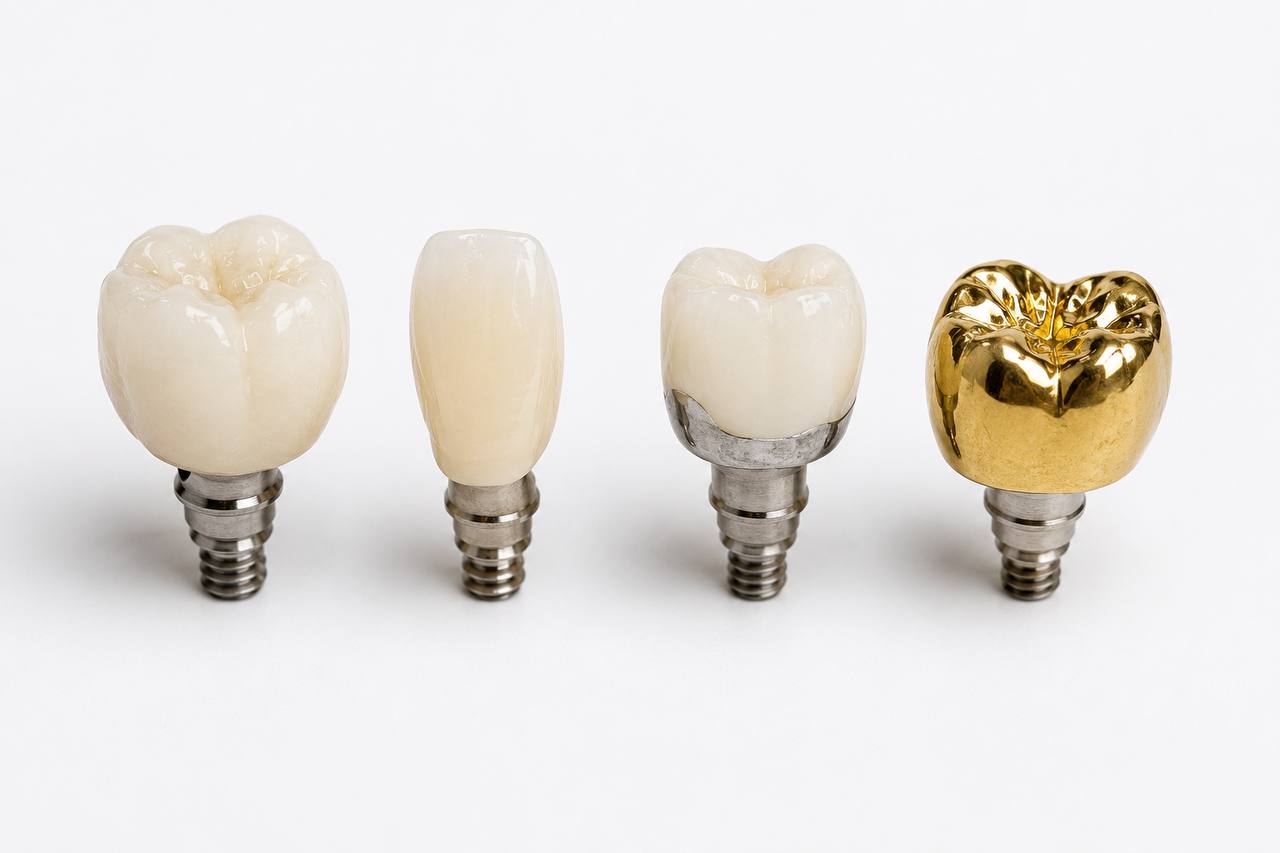
Implant Crown Materials: How to Choose Between Zirconia, E.max, PFM, and Gold
Implant crown material selection is a different clinical decision than material selection for tooth-supported crowns. The implant does not have a periodontal ligament. It does not flex. It does not absorb and redistribute occlusal force the way a natural tooth does. These differences matter at the material level — and a material choice that works well on a natural tooth preparation may not be the optimal choice on an implant.
This guide covers the four main materials used for implant-supported single crowns — zirconia, e.max, PFM, and full-cast gold — with specific attention to what makes each suitable or unsuitable in the implant context. It is written from BioDent’s laboratory perspective, based on what we fabricate, what we see fail, and what consistently produces good outcomes.
Why Implant Crowns Are Different
Before comparing materials, it is worth being precise about what makes implant crown material selection different from conventional crown material selection.
No periodontal ligament cushioning. A natural tooth has approximately 0.25 mm of periodontal ligament that acts as a shock absorber under occlusal load. An osseointegrated implant is in direct contact with bone — there is no ligament, no proprioceptive feedback, and no load distribution mechanism. Occlusal forces transmit directly to the implant-bone interface. This increases the mechanical demand on the prosthetic component and makes material fracture resistance more clinically significant.
Retention via screw or cement, not biological attachment. The crown connects to the implant through a mechanical interface — either a screw channel or a cemented abutment connection. The quality of that interface, and the material’s ability to maintain dimensional stability at the connection, affects long-term fit and retrievability.
Tissue response at the peri-implant margin. The material at and near the gingival margin interacts with peri-implant soft tissue. Biocompatibility, surface roughness, and margin position all affect tissue health in ways that compound over time.
Higher mechanical demands in bruxism and parafunction cases. Without the proprioceptive feedback of a natural periodontal ligament, patients with parafunctional habits often load implant crowns harder than natural teeth. Material fracture resistance matters more in this population than it does for tooth-supported restorations.
Zirconia: The First-Choice Material for Most Implant Cases
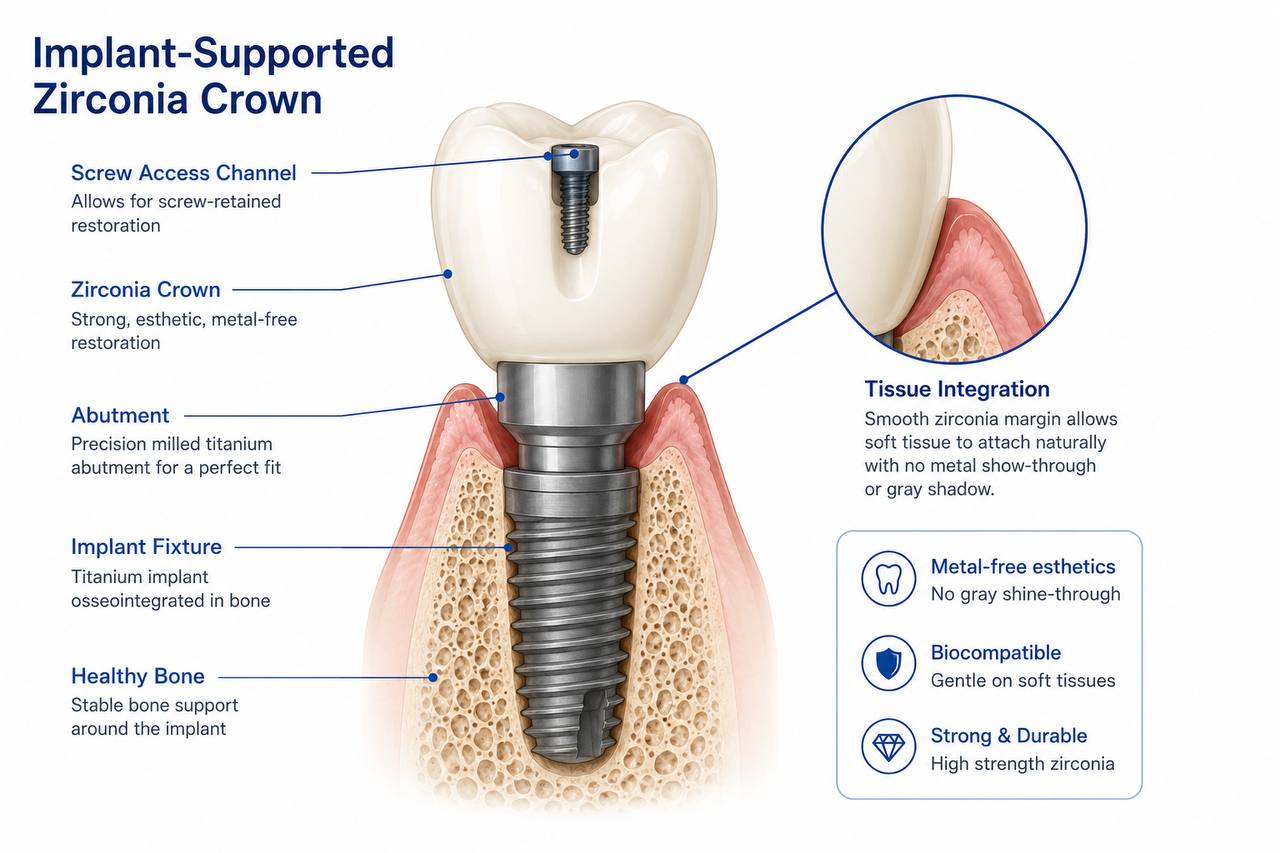
Zirconia has become the dominant material for implant-supported single crowns for good clinical reasons. Its combination of strength, biocompatibility, and esthetic versatility makes it uniquely well-suited for implant work.
Strength. Monolithic zirconia has flexural strength in the range of 900–1,200 MPa depending on formulation — significantly higher than e.max at approximately 400 MPa and substantially higher than feldspathic porcelain. For a restoration sitting on a rigid implant interface without periodontal ligament cushioning, this strength advantage is clinically meaningful.
Biocompatibility. Zirconia has an extensively documented record of soft tissue compatibility. The smooth, low-surface-energy ceramic surface does not attract plaque the way metal surfaces do, and peri-implant tissue response to zirconia margins is consistently favorable in the clinical literature.
No metal show-through. Zirconia has no metal substructure, which means there is no gray shadow at the tissue margin even if the tissue recedes over time. For anterior implant cases this is a significant esthetic advantage over PFM.
Screw-retained fabrication. Zirconia can be fabricated as a screw-retained implant crown with a precisely positioned access channel. The access channel is filled with composite after seating. This retrieval option is not available with conventional cemented PFM or e.max crowns without a custom abutment in the workflow.
Where standard monolithic zirconia has a limitation: esthetic cases in the anterior zone where incisal translucency and light behavior must approximate natural dentition. Standard monolithic zirconia is more opaque than natural enamel. For these cases, ultra-translucent zirconia or layered zirconia is the appropriate material — not standard monolithic.
PFM on Implants: Functional but Narrowing
Porcelain-fused-to-metal remains a viable option for implant-supported crowns, and in some specific clinical situations it retains genuine advantages. But its role in implant prosthodontics has narrowed alongside its role in conventional crown and bridge work.
Where PFM still makes sense on implants:
Cases where the patient has a documented history with PFM and a preference to continue with the material. Long-span implant-supported bridges where the metal framework’s tensile strength and span rigidity are clinically meaningful. Cases where cost is a hard constraint and the patient understands the esthetic limitations.
Where PFM is clinically disadvantaged on implants:
The metal margin is the primary liability. On natural teeth, the margin can often be positioned subgingivally where the metal is not visible. On implants, particularly when tissue levels are affected by bone resorption or when the patient has a high lip line, metal collar visibility is a real risk. Over time, as peri-implant tissue remodels, a metal margin that was initially subgingival can become visible.
Porcelain chipping remains the same failure mode it is for tooth-supported PFM. The rigid implant interface without periodontal ligament cushioning may increase occlusal stress concentration at the ceramic-metal interface in some loading conditions.
PFM on implants is not a wrong choice in the right clinical situation. It is a choice that requires clear-eyed assessment of the esthetic risk at the margin and the long-term tissue remodeling trajectory for that specific patient.
Full-Cast Gold: The Underused Option for the Right Patient
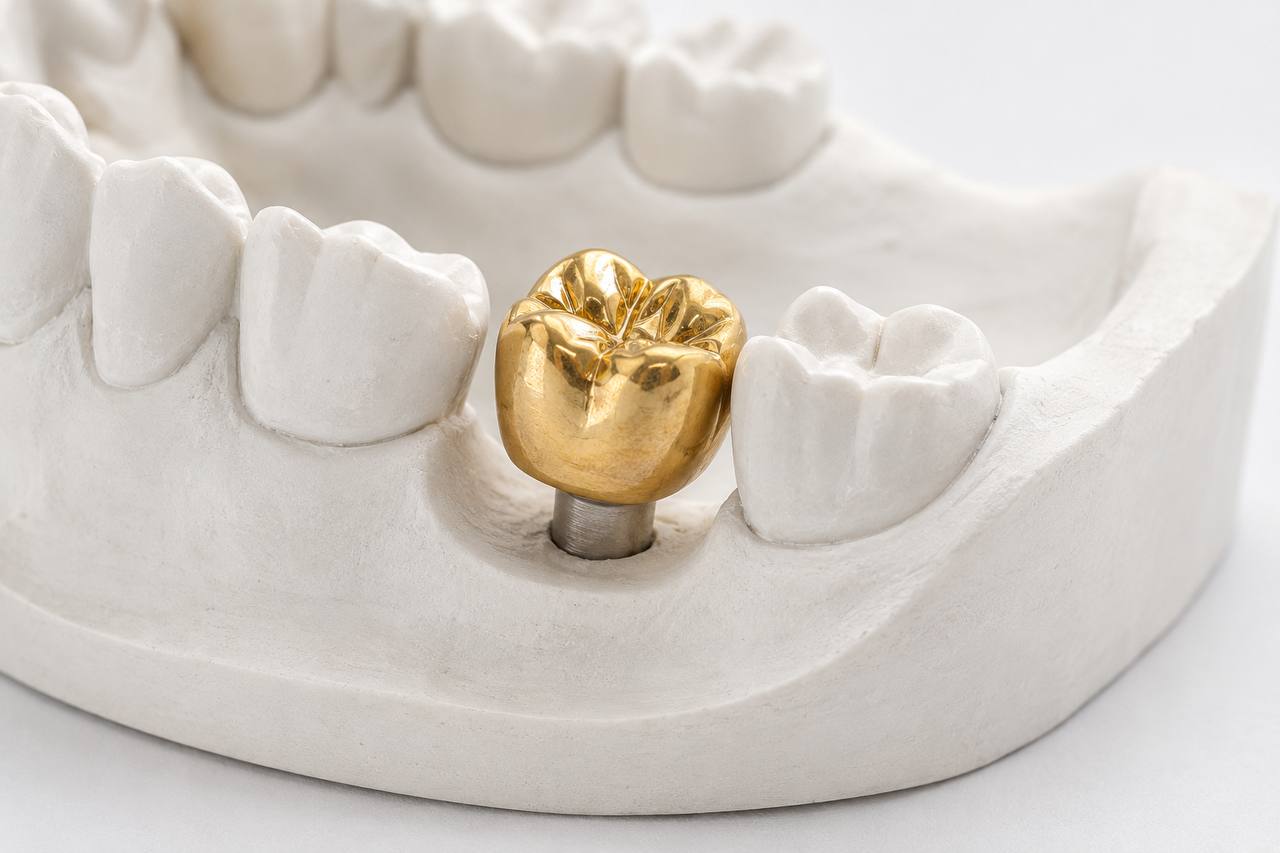
Full-cast gold crowns for implant-supported restorations are prescribed infrequently in contemporary practice — not because they perform poorly, but because esthetic expectations in most patient populations make the material a difficult conversation.
For the right patient, full-cast gold on an implant is arguably the most clinically ideal single-crown material available.
Strength. Gold alloy crowns have no fracture mode under normal occlusal load. They do not chip, they do not crack, they do not fail in the ways that ceramic materials can. For patients with heavy occlusal load, bruxism, or a documented history of ceramic fracture, this is a significant advantage.
Wear compatibility. Well-formulated gold alloys wear at a rate compatible with natural tooth enamel — they do not excessively wear opposing dentition the way some zirconia formulations do when the surface becomes rough or loses its glaze. For implant cases involving natural tooth antagonists this is a genuine long-term consideration.
Marginal fit. Cast gold has been the benchmark for marginal accuracy in dental laboratory work for decades. A well-cast gold crown on a correctly prepared implant abutment achieves marginal fit that all-ceramic options match but rarely exceed.
Biocompatibility. High-noble gold alloys have excellent soft tissue compatibility and a long clinical record at peri-implant margins.
The limitation is entirely esthetic. A gold crown on an upper anterior implant is not a clinical option for most patients. On a lower second molar — particularly in an older patient with heavy occlusal load who has fractured ceramic crowns before — the conversation about gold deserves to happen.
Head-to-Head Comparison for Implant Crowns
| Feature | Zirconia (Monolithic) | Zirconia (Ultra-T) | E.max | PFM | Full Gold |
|---|---|---|---|---|---|
| Flexural strength | Very high | High | Moderate | High (metal) | Very high |
| Fracture risk | Very low | Low | Moderate | Low (porcelain chip risk) | None |
| Anterior esthetics | Good | Excellent | Excellent | Limited | Poor |
| Posterior esthetics | Good | Good | Good | Acceptable | Poor |
| Metal margin risk | None | None | None | Yes | None |
| Bruxism suitability | Excellent | Good | Avoid | Acceptable | Excellent |
| Biocompatibility | Excellent | Excellent | Excellent | Good | Excellent |
| Retrievability (screw) | Yes | Yes | With custom abutment | With custom abutment | Yes |
| Typical lab cost | $130–$200 | $160–$230 | $160–$240 | $120–$180 | $150–$220 |
The Abutment Question: Stock vs. Custom
Material selection and abutment selection are connected decisions. The abutment type affects what material options are available and how well each material performs.
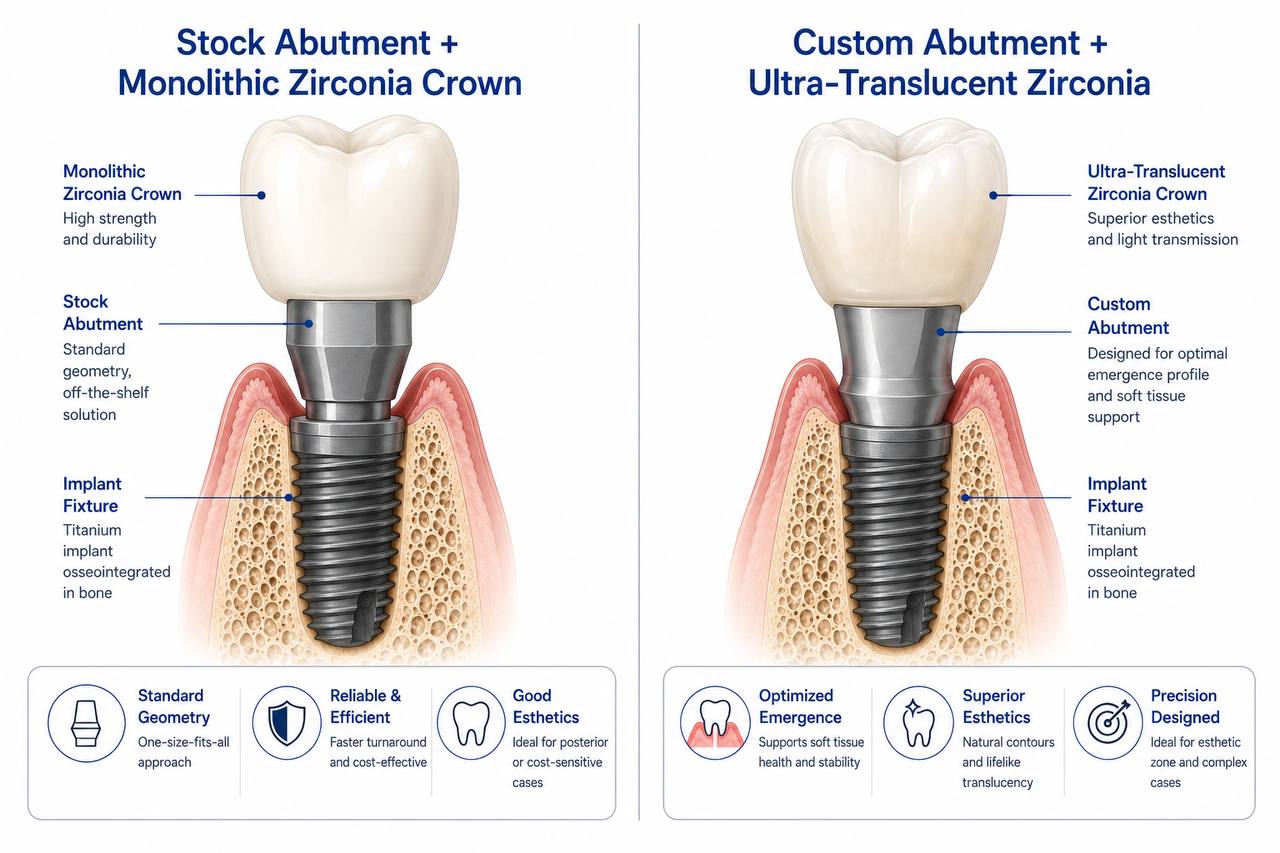
Stock abutments are pre-fabricated in standard geometries. They are efficient, widely available, and appropriate for straightforward cases where the implant position is ideal and the restoration does not require precise emergence profile control. With a stock abutment, crown material selection is constrained by the available preparation geometry — if the abutment height or angulation is not ideal for e.max reduction requirements, for example, the material choice should adjust accordingly.
Custom abutments are designed specifically for the patient’s implant position, soft tissue contours, and planned final restoration. They allow precise control over emergence profile, margin position, and preparation depth — which in turn allows the optimal material to be selected for the case rather than the available geometry.
For high-esthetic anterior implant cases, a custom abutment and e.max or ultra-translucent zirconia crown is the combination that consistently produces the most natural-appearing results. For straightforward posterior single units, a stock abutment and monolithic zirconia is efficient, cost-effective, and clinically reliable.
BioDent fabricates both custom CAD/CAM abutments and implant crowns as combined cases, designing the abutment emergence profile and crown contour as a unified system.
For a detailed comparison of stock and custom abutment options, see our guide: Stock vs. Custom Abutments — Which Is Right for Your Case?
How to Specify Implant Crown Material on Your Prescription
Clear material specification on the prescription eliminates the most common source of implant crown fabrication errors — assumptions.
Write the implant manufacturer, system name, implant diameter, and platform connection for each implant position. Specify the abutment type: stock with part number, or custom designed by BioDent. Specify the crown material explicitly: monolithic zirconia, ultra-translucent zirconia, layered zirconia, pressed e.max, PFM, or full-cast gold. Note whether the restoration is screw-retained or cement-retained. Include the shade.
If you have clinical notes that affect material selection — bruxism, high esthetic demand, limited preparation depth, adjacent natural teeth requiring shade matching — include them. The laboratory uses that information to make better fabrication decisions and to flag potential issues before production begins rather than after.
A prescription that says “implant crown, upper right central, Nobel” leaves BioDent making four or five material and design decisions that should be made by the dentist. A prescription that says “upper right central, Nobel Active 3.5mm RP, custom titanium abutment, ultra-translucent zirconia, screw-retained, shade A2, high esthetic priority, no parafunction” gives the laboratory everything it needs to fabricate the right restoration.
Frequently Asked Questions
Is zirconia always the right choice for implant crowns?
lass=”yoast-text-mark” />>For most posterior single units and most cases involving patients with parafunction, yes — monolithic zirconia is the most reliable choice. For anterior esthetic cases without parafunction, ultra-translucent zirconia or e.max are often superior in esthetic outcome. For patients with extreme occlusal demands who understand the esthetic tradeoff, full-cast gold is a legitimate clinical option.
Can e.max be used on a screw-retained implant crown?
Yes, with a custom abutment workflow. The e.max crown is cemented onto a custom titanium or zirconia abutment that is then screw-retained in the implant. This adds fabrication steps and cost but allows e.max esthetics with a retrievable interface.
Does zirconia wear opposing natural teeth?
Polished and glazed zirconia has wear characteristics comparable to natural enamel. Unpolished or roughened zirconia — from adjustment without re-polishing — wears opposing dentition more aggressively. Any intraoral adjustment to a zirconia crown should be followed by re-polishing with appropriate zirconia polishing protocols.
What does BioDent recommend for a bruxer with an upper anterior implant?
Ultra-translucent zirconia with a carefully designed occlusal scheme that minimizes lateral forces on the anterior implant. If the patient has severe bruxism documented by multiple ceramic fractures, a night guard as part of the treatment plan is an important recommendation regardless of material choice.
How long do implant crowns last?
Material longevity for implant crowns is well-documented. Monolithic zirconia and full-cast gold crowns have no clinically significant fracture mode under normal function. E.max survival rates at five years are high for correctly indicated cases. PFM longevity is comparable to tooth-supported PFM. The implant-crown interface — the abutment screw and connection — requires periodic torque verification as part of maintenance, regardless of crown material.
Send Your Implant Crown Cases to BioDent
BioDent fabricates implant-supported crowns in all materials — monolithic and ultra-translucent zirconia, layered zirconia, pressed e.max, PFM, and full-cast gold — alongside custom CAD/CAM abutments for cases requiring a unified design approach. We work with Nobel Biocare, Straumann, Zimmer Biomet, BioHorizons, Implant Direct, and all other major implant systems.
Also relevant: Screw-Retained vs. Cement-Retained Implant Crowns · PFM vs. Zirconia vs. E.max: Full Comparison · Stock vs. Custom Abutments