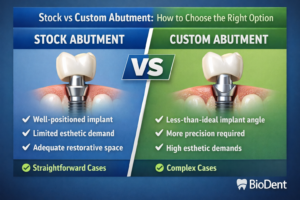
When choosing between a stock abutment and a custom abutment, the right answer usually depends on the restorative demands of the case. A stock abutment may be acceptable when implant position is favorable, tissue conditions are straightforward, and esthetic demands are limited. A custom abutment is often the better choice when emergence profile, tissue support, implant angulation, restorative space, or esthetic control matter more.
For dentists, the question is not whether custom is always better in theory. The real question is which option gives you the most predictable restorative result for that specific implant case.
What Is a Stock Abutment?
A stock abutment is a prefabricated implant component made in standard shapes, sizes, and angles. It is designed to fit a compatible implant platform without being individually designed for the patient’s soft tissue contour, implant depth, or final crown profile.
In straightforward cases, a stock abutment can be a practical restorative option. It may work well when the implant is ideally positioned and the prosthetic requirements are relatively simple.
What Is a Custom Abutment?
A custom abutment is an implant abutment designed for the specific case rather than selected from a standard catalog shape. It is typically created using a digital workflow based on the implant position, soft tissue profile, restorative space, and the intended final restoration.
That individualization is what makes custom abutments especially valuable in cases where the restoration needs more precise control. BioDent already offers custom abutments compatible with major implant platforms and positions them as a cost-effective alternative to manufacturer abutments, which makes this comparison page a strong support asset for the site’s implant cluster.
Stock vs Custom Abutment: What Actually Changes?
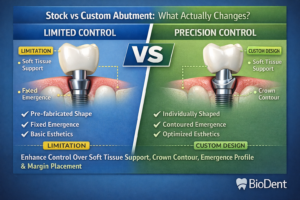
The most important difference is not simply whether the abutment is made in advance or designed case by case. The difference is how much restorative control the dentist and lab have.
With a stock abutment, the clinician works within a predefined shape. That can be enough in simple posterior cases, but it may limit control over soft tissue support, crown contour, margin placement, and emergence profile.
With a custom abutment, the restorative design can be built around the case. That often makes more sense when the implant is not in an ideal position, when esthetics matter more, or when the crown needs a more controlled path of insertion and contour.
When a Stock Abutment Can Work
A stock abutment can still be a reasonable option in cases such as:
-
a well-positioned posterior implant
-
limited esthetic demand
-
adequate tissue architecture
-
sufficient restorative space
-
cases where the final crown contours are relatively uncomplicated
The point is not to eliminate stock abutments from the decision tree. The point is to know where they remain efficient and where they may begin to limit the result.
When a Custom Abutment Is Usually the Better Choice
A custom abutment is often the stronger restorative choice when the case requires more precision.
Common examples include:
-
anterior or high-esthetic cases
-
implants placed at a less-than-ideal angle
-
cases where tissue shaping and emergence profile matter
-
limited restorative space
-
implant crowns that need more controlled support and contour
-
situations where the doctor wants a more customized screw-retained or cement-retained solution
This is especially relevant for practices that want more consistency in implant restorative outcomes rather than simply selecting the most convenient component.
BioDent’s implant section and custom abutment service already support this kind of case-based restorative planning, so this article should internally link back to those commercial pages rather than function as a standalone educational post.
Why Emergence Profile Matters in the Abutment Decision
One of the biggest practical reasons to choose a custom abutment is control of emergence profile.
A stock abutment may be clinically acceptable, but it does not always support the ideal transition from implant platform to final crown contour. In more demanding cases, that can create compromises in tissue support, esthetics, or restorative form.
A custom abutment allows the lab to design the transition more intentionally. That is often important in visible zones, in cases with unique tissue contours, and in implant positions that need restorative compensation.
How Implant Position Influences the Choice
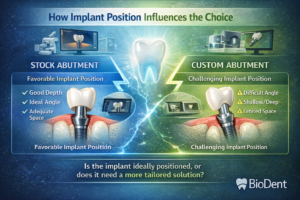
Implant position is one of the clearest decision drivers.
If the implant is placed in a favorable position with good depth, angle, and restorative space, a stock abutment may still deliver an acceptable result.
If the implant position is more challenging, the case may benefit from a custom abutment because the restorative team needs greater flexibility in shaping the final restoration and supporting the soft tissue correctly.
This is one reason custom abutment content works so well for BioDent’s site: the lab already emphasizes digital workflow support, implant restorations, and custom hardware collaboration with clinicians.
Material Considerations: Titanium, Zirconia, and Hybrid Options
The abutment decision is not only about stock versus custom. Material also matters.
Titanium
Titanium is often used when strength, durability, and broad restorative reliability are the main priorities.
Zirconia
Zirconia may be considered when esthetics are more important, especially in visible areas where color and soft tissue presentation matter more.
Hybrid Options
In some workflows, a hybrid or Ti-base-related approach may be appropriate depending on the design of the final restoration and the restorative goals of the case.
BioDent’s current custom abutment service references titanium, gold-hue titanium, and zirconia hybrid custom abutments, so the site already has a foundation for a deeper material cluster later.
Stock vs Custom Abutment in Screw-Retained Cases
In screw-retained workflows, the abutment decision can become even more important because access channel location, restorative contours, and crown design all need to work together.
A custom abutment may be preferred when the case needs more controlled alignment or when the restorative design requires a more individualized solution. That does not mean every screw-retained case requires custom design, but it does mean the choice should be made intentionally.
This article should eventually be linked with a separate screw-retained comparison page so BioDent can build a stronger implant-restorative topic cluster around abutments, retrievability, and digital planning.
What the Lab Needs Before Fabrication
This is one of the most commercially important parts of the page because it connects search intent to real lab workflow.
Before fabricating a custom abutment, the lab should ideally receive:
-
implant system and platform information
-
digital scan or conventional impression
-
scan body information when relevant
-
restorative prescription
-
soft tissue or emergence profile notes when needed
-
opposing and bite records if required
-
shade and material preferences
-
indication of whether the case is planned as screw-retained or cement-retained
BioDent already provides a dedicated Send A Digital Impression workflow and broader case submission paths, so this article should push readers directly into that next step.
Common Signs a Case Should Be Reviewed for a Custom Abutment
A dentist should strongly consider custom-abutment review when:
-
the implant is angled or deeply placed
-
the case is in the smile zone
-
soft tissue shaping matters
-
the final crown contour is difficult to manage with a standard component
-
there is concern about restorative space
-
the case needs more control before finalizing the restoration design
This is where a good lab relationship matters. The earlier the review happens, the easier it is to avoid downstream compromises.
How BioDent Can Support Custom Abutment Cases
BioDent already presents itself as a digital dental laboratory with implant services, custom abutments, digital impression intake, and case submission options for dentists. That means this page can do more than educate. It can move the reader toward a real action.
For a practice evaluating stock vs custom abutment options, the next logical step is simple:
-
send the implant case for review
-
confirm implant platform and restorative plan
-
discuss whether the case should stay with a stock option or move to a custom design
-
align the lab workflow before fabrication begins
FAQ
Is a custom abutment always better than a stock abutment?
No. A stock abutment can still work well in straightforward cases. A custom abutment is usually more valuable when the case requires more control over emergence profile, tissue support, angulation, or esthetics.
When should a dentist strongly consider a custom abutment?
Custom abutments are often worth considering in anterior cases, angled implants, cases with limited restorative space, or whenever the final restoration needs more individualized support.
Can a stock abutment still be used in posterior implants?
Yes. In some posterior cases with favorable implant placement and lower esthetic demand, a stock abutment may still be a practical option.
What information should be sent to the lab for a custom abutment case?
At minimum, the lab should receive implant platform details, a digital scan or impression, restorative instructions, and any relevant notes about tissue, occlusion, and final crown design. BioDent already supports digital impression transfer and case submission workflows for that process.