All-on-4 Dental Lab Requirements: What the Lab Needs to Get It Right
All-on-4 is one of the most demanding prosthetic cases a dental practice can take on. The surgical precision required is well documented. What receives less attention is the laboratory side of the case — and that side of the equation is just as capable of producing a poor outcome as a misplaced implant.
A well-executed All-on-4 case requires a laboratory that understands full-arch implant prosthetics at a technical level, communicates clearly at each stage, and receives case information complete enough to work from. Gaps in any of those areas show up in the final prosthesis — in the fit, the occlusion, the esthetics, or the long-term durability.
This guide covers what BioDent needs from the dental practice to fabricate an All-on-4 prosthesis correctly: materials, case documentation, timeline, and the most common points where the lab-practice workflow breaks down.
What All-on-4 Actually Requires From a Laboratory
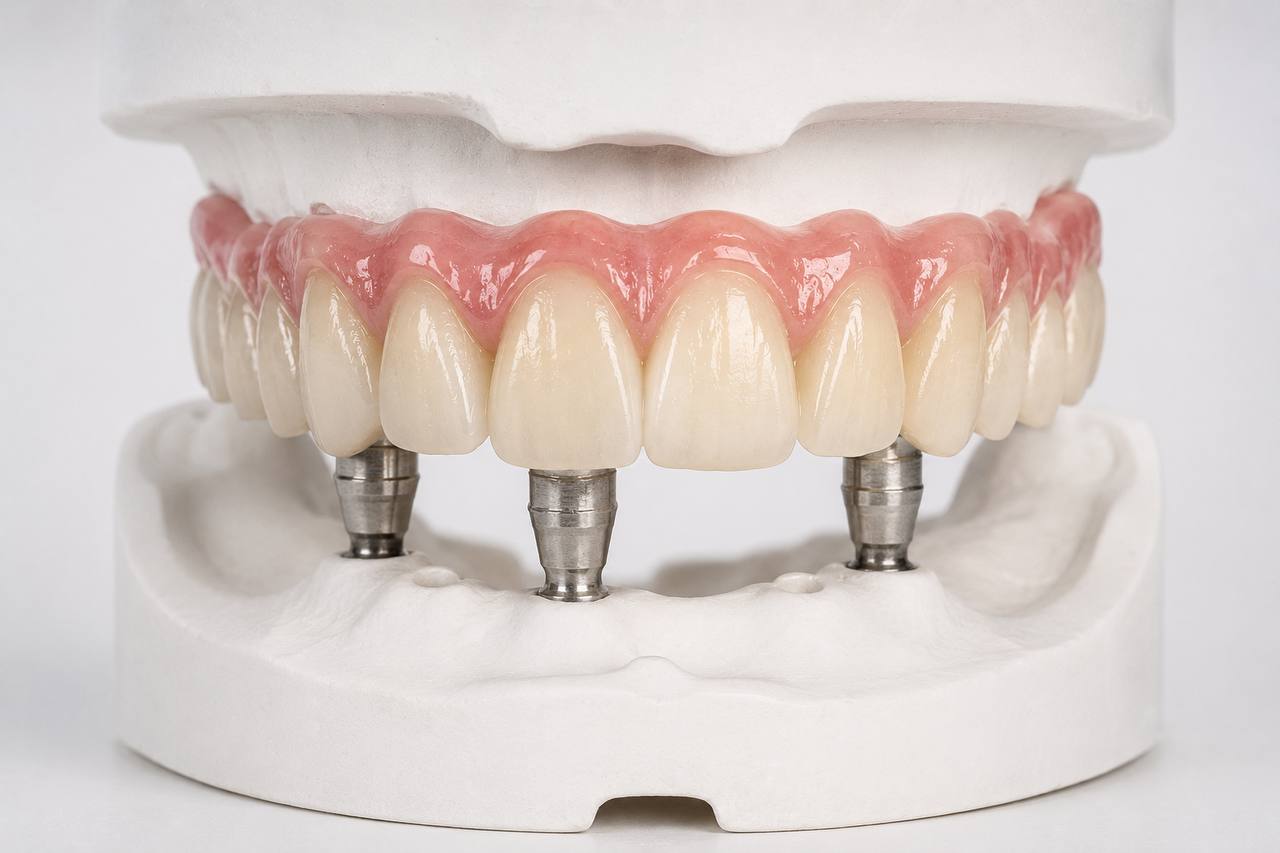
All-on-4 is not a scaled-up version of a single crown case. It involves full-arch design, multiple implant interfaces, precise vertical dimension management, phonetics, esthetics across an entire arch, and a prosthesis that must function under full occlusal load for years. Every stage of laboratory fabrication is more complex than single-unit work.
The laboratory needs to understand the implant systems involved, design the prosthesis in relation to the opposing arch, manage the pink esthetic component alongside the teeth, and fabricate a restoration whose fit across four or six implant connections is precise enough to seat passively. A prosthesis that does not seat passively — that requires force to seat or creates stress at the implant interface — is a clinical problem that originates in the laboratory, not at the chair.
BioDent fabricates All-on-4 and full-arch implant prostheses from our Matawan, NJ facility. We work with all major implant systems and handle both digital and analog case workflows.
Stage 1: The Provisional Prosthesis
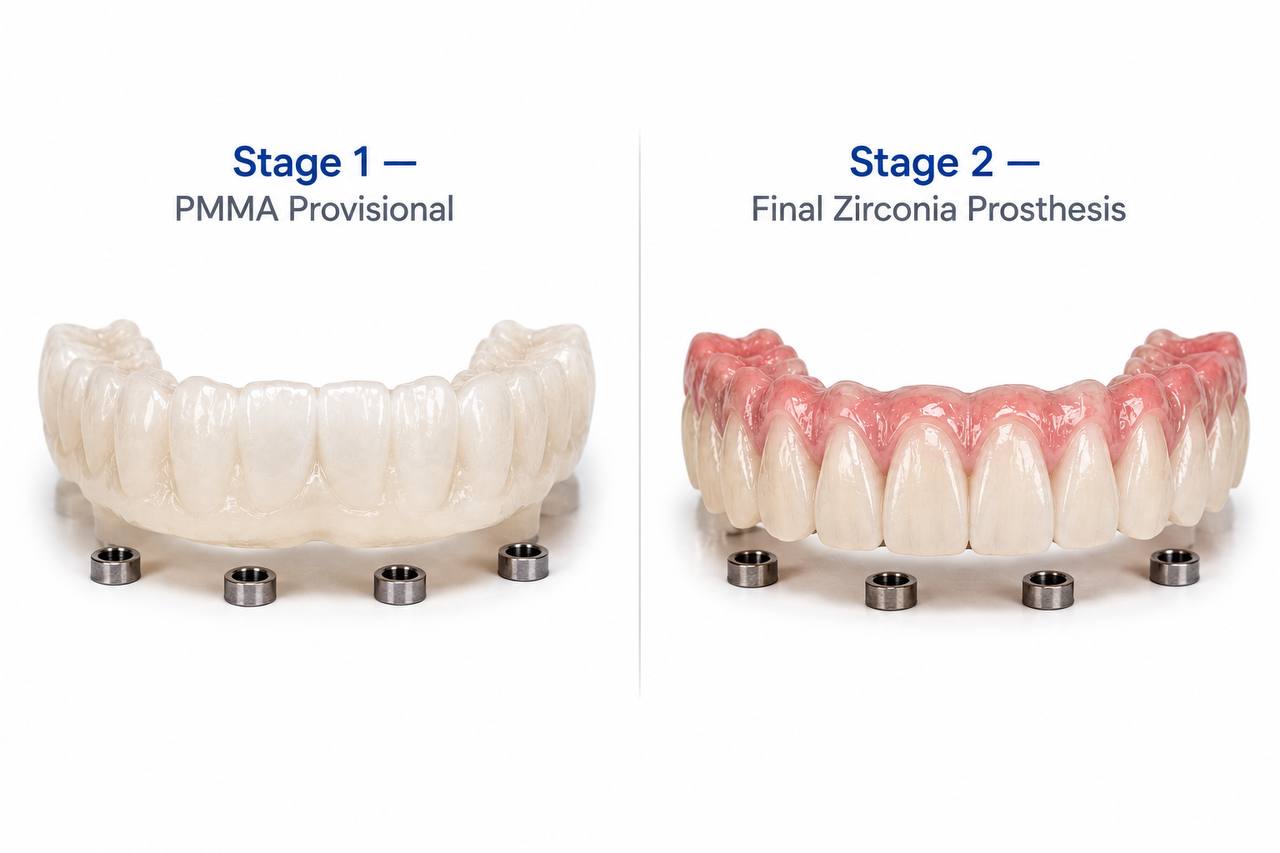
Most All-on-4 protocols involve immediate loading — the patient leaves surgery with a functioning provisional prosthesis placed the same day. This provisional is not a temporary compromise. It is the reference the final prosthesis will be built from, and its quality directly determines the quality of the final outcome.
The provisional also plays several critical clinical roles at the same time. It defines the patient’s vertical dimension of occlusion while providing an opportunity to assess phonetics, lip support, and smile esthetics under real clinical conditions. During the healing phase, it helps shape and support the peri-implant soft tissues. At the same time, it captures the functional and esthetic information the dental laboratory relies on to design and fabricate the definitive prosthesis.
What BioDent needs for the provisional:
The implant positions — either via a scan with scan bodies in place or via an open-tray implant-level impression using the correct impression copings for each system. The existing vertical dimension and occlusal records. Any esthetic reference — photographs of the patient’s pre-extraction dentition, smile photographs, or a description of the desired tooth form and shade.
Provisional prostheses for immediate loading are typically fabricated in PMMA — a durable acrylic that can be adjusted chairside, polished, and modified as the treatment progresses. BioDent can fabricate the provisional before surgery based on pre-surgical records, or on an emergency turnaround from post-surgical impressions if the clinical situation requires it.
Stage 2: Records From the Provisional Phase
The provisional phase — typically three to six months — is when the critical records for the final prosthesis are gathered. This stage is where most laboratory problems originate, because inadequate records at this stage cannot be compensated for during fabrication.
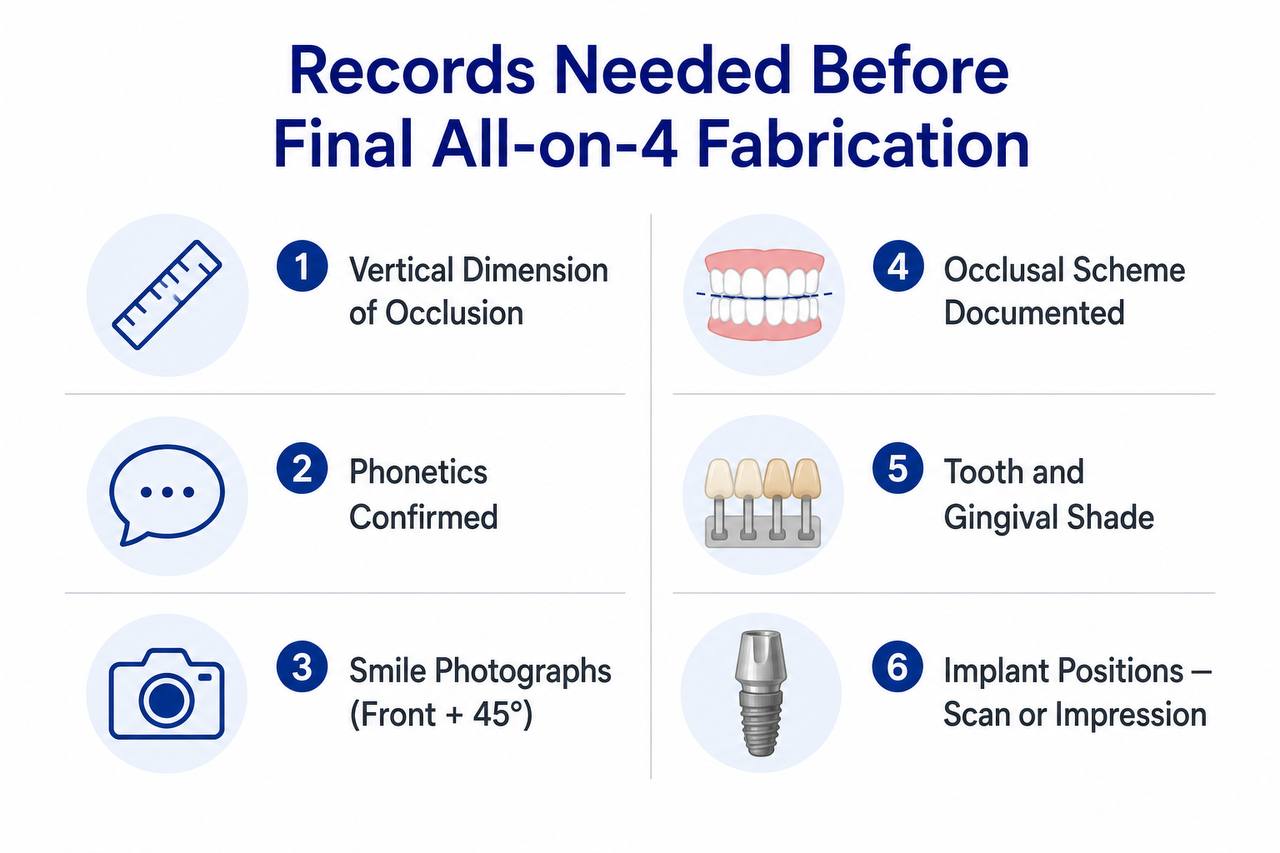
- Vertical dimension of occlusion. Confirm and document the VDO established in the provisional. If adjustments were made during the provisional phase, record the final VDO before making the final impression.
- Phonetics and lip support. Document whether the patient reports any phonetic issues with the provisional and whether lip support is adequate. These are design parameters the laboratory needs to replicate or adjust in the final prosthesis.
- Smile esthetics. Photograph the patient wearing the provisional from the front and at 45 degrees with lips relaxed and smiling. These photographs are the laboratory’s primary esthetic reference. Without them, the laboratory is designing the final prosthesis without knowing whether the provisional’s esthetic parameters were acceptable.
- Occlusal scheme. Document the occlusal contacts in the provisional and whether any adjustments were made. The final prosthesis will be designed to replicate the established occlusal scheme.
- Shade. Confirm tooth shade and gingival ceramic shade if applicable. If the patient requested shade adjustments during the provisional phase, document the final approved shade.
Stage 3: The Final Impression or Scan
The final impression or scan captures the implant positions with sufficient accuracy for the laboratory to fabricate a passively fitting full-arch prosthesis. This is technically the most demanding impression in restorative dentistry, and errors here cannot be corrected at the laboratory level.
- For digital cases: A full-arch scan with scan bodies correctly seated in each implant. Scan body selection must match the implant system and interface exactly — scan bodies from the wrong system produce incorrect implant position data. Include the opposing arch scan and a bite record scan. Photograph the patient in occlusion with the provisional in place before removing it for the final scan.
- For analog cases: Open-tray implant-level impressions using verified impression copings for each implant system and interface. Splinting the impression copings together before making the impression — using a rigid, low-shrinkage material — reduces the risk of coping movement and improves accuracy across the full arch.
Include a facebow transfer where the clinical protocol supports it.
In both cases, include the provisional prosthesis or a duplicate of it. The laboratory uses the provisional as a reference for tooth position, gingival contour, and overall arch form.
What to send:
The scan files or impression in a rigid, labeled container. The provisional prosthesis or a clear duplicate. All shade records. The occlusal records. Photographs from the provisional phase. The implant system, manufacturer, diameter, and platform for each position — specified per implant, not just as a general note.
Materials for the Final All-on-4 Prosthesis
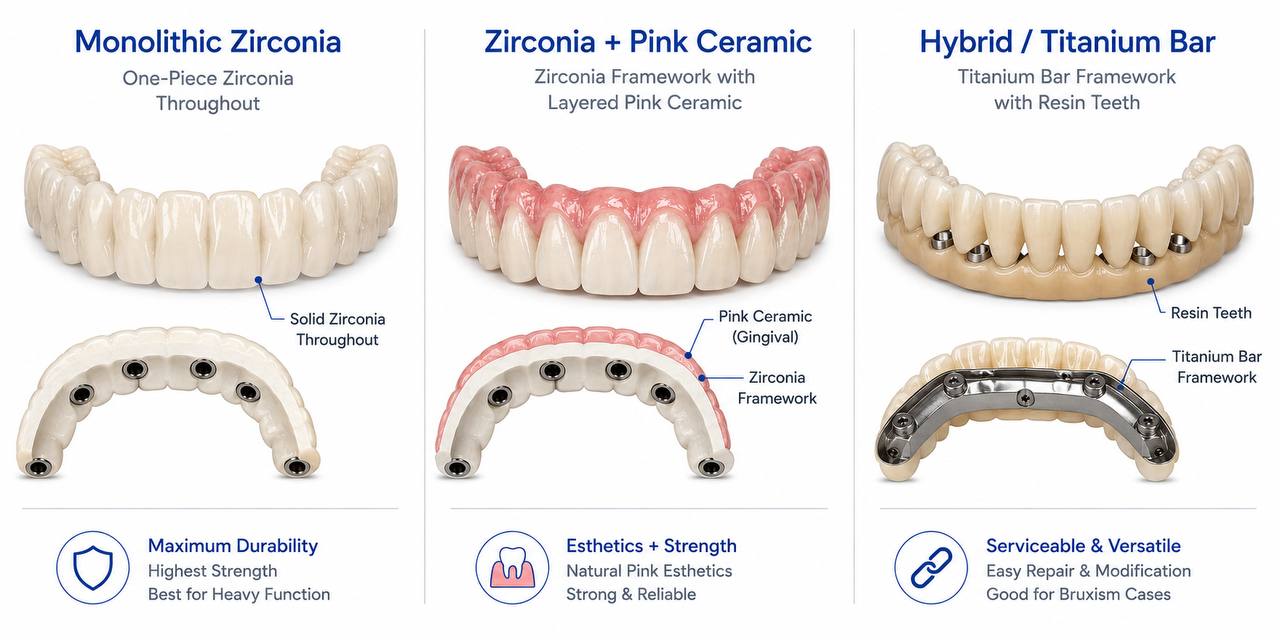
The material choice for the final prosthesis involves tradeoffs between esthetics, repairability, weight, and long-term durability. The main options are monolithic zirconia, zirconia with pink ceramic gingival simulation, and hybrid ceramic on a titanium framework.
Monolithic Full-Arch Zirconia
A single continuous zirconia structure milled from a full-arch block or assembled from multiple milled segments. The teeth and gingival simulation are all zirconia — stained and characterized, no separate ceramic component.
The advantage is durability. Monolithic zirconia does not chip or fracture under normal function. It is the most robust final prosthesis option available.
The limitation is repairability. If a tooth fractures — which is rare but possible — chairside repair of zirconia is difficult. The prosthesis typically needs to return to the laboratory. Weight is also a consideration: full-arch zirconia prostheses are heavier than acrylic alternatives, which some patients notice during adaptation.
Zirconia with Layered Pink Ceramic
The teeth and framework are milled zirconia, with hand-layered feldspathic ceramic used for the gingival simulation and any detailed characterization. This produces superior esthetic results — particularly in the gingival zone — at the cost of a small chipping risk in the ceramic component.
For cases where esthetics are a priority and the patient understands the maintenance implications, this is the highest-esthetic full-arch option.
Hybrid Ceramic on Titanium Framework
A milled titanium bar provides the structural foundation and implant connections. PMMA or composite resin teeth are attached to the bar, either pre-fabricated or custom milled. This construction is lighter than full zirconia, more repairable chairside, and lower in cost.
The tradeoff is longevity. Hybrid materials wear more than zirconia over time and may require tooth replacement or prosthesis remake within five to ten years in high-use cases. For younger patients or high-demand functional cases, the long-term cost-of-ownership calculation often favors zirconia despite the higher initial investment.
Timeline: What to Expect at Each Stage
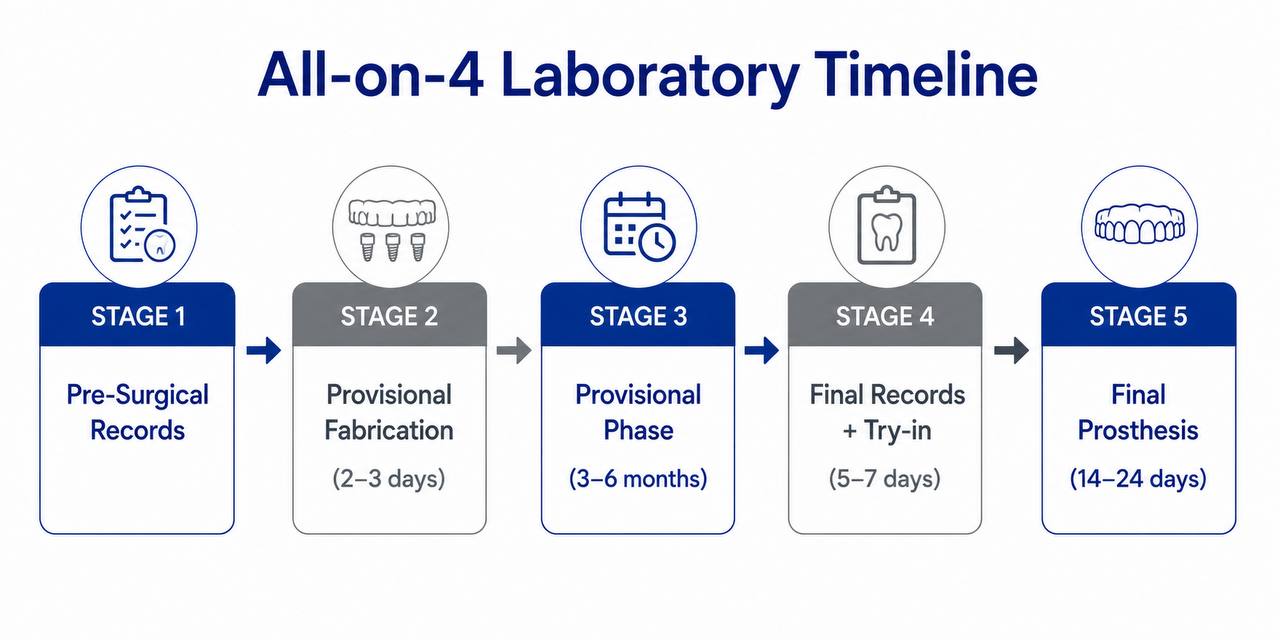
All-on-4 is not a case type where rush service meaningfully applies. The fabrication timeline reflects the actual clinical and technical requirements of full-arch prosthetics. Compressing it introduces risk.
Provisional prosthesis (immediate loading):
If pre-surgical records are provided, BioDent can fabricate the provisional before surgery for day-of placement. If post-surgical impressions are the workflow, turnaround is two to three business days for PMMA provisionals.
Try-in framework (if applicable):
For cases using a try-in step to verify passive fit and occlusion before final fabrication, the milled try-in framework is typically returned within five to seven business days from receipt of the final impression or scan.
Final prosthesis — monolithic zirconia:
Fourteen to eighteen business days from receipt of complete records and try-in approval. This includes CAD design, full-arch milling, sintering, staining, glazing, and quality review.
Final prosthesis — zirconia with layered ceramic:
Eighteen to twenty-four business days. The additional ceramic layering and firing cycles extend the timeline.
Final prosthesis — hybrid:
Ten to fourteen business days depending on construction type.
Rush service is not available for final All-on-4 prostheses. Attempting to compress fabrication time on a full-arch case increases the risk of fit issues, shade inconsistency, and quality problems that cost more time to resolve than the compression saved.
The Most Common Lab-Practice Workflow Failures
Most All-on-4 outcomes that disappoint — poor esthetics, passive fit issues, occlusal problems at delivery — trace back to one of a small number of recurring workflow failures. Understanding them is the most practical way to avoid them.
Incomplete implant system information. Sending “four Nobel implants” is not sufficient. The system name, platform size, connection type, and diameter for each implant position are required to select the correct implant analogs and design accurate connections. Wrong analog selection produces a prosthesis that does not fit.
No photographs from the provisional phase. The laboratory cannot design the final prosthesis esthetics without knowing whether the provisional esthetics were acceptable. Photographs are not optional documentation — they are fabrication requirements.
Provisional not included with final records. The provisional contains the clinically verified tooth position, vertical dimension, and arch form. Without it, the laboratory designs the final prosthesis from records alone, losing the clinical validation that the provisional phase provides.
Assuming the lab knows your preferences. BioDent works with hundreds of practices. Unless your case notes specify tooth form, shade depth, surface texture, gingival contour preferences, and midline position, the laboratory will make reasonable default decisions. Those decisions may not match your or the patient’s expectations. Specify what you want.
Requesting delivery before the timeline supports it. A full-arch zirconia prosthesis cannot be correctly fabricated in five days. If the clinical schedule requires delivery at a date that the fabrication timeline cannot support, the outcome is predictably compromised. Build the laboratory timeline into your treatment planning, not around it.
Frequently Asked Questions
Does BioDent work with all implant systems for All-on-4 cases?
Yes. BioDent works with Nobel Biocare, Straumann, Zimmer Biomet, BioHorizons, Implant Direct, and other major systems. Specify the manufacturer, system name, platform, and diameter for each implant position on your prescription.
Can BioDent fabricate the provisional for immediate loading?
Yes, if pre-surgical records are provided. Contact BioDent before surgery to coordinate timing and confirm what records are needed. For cases where provisionals must be fabricated post-surgically, two to three business day turnaround is standard.
Is a try-in step required?
Not required, but strongly recommended for most full-arch cases. A try-in verifies passive fit and allows occlusal and esthetic adjustments before final fabrication. Skipping the try-in step increases the risk of delivery-day adjustments or remakes.
What if the patient wants changes to esthetics at delivery?
Minor adjustments — shade, surface texture, minor contour changes — can often be handled at BioDent without a full remake. Significant esthetic changes that require redesign typically require new records and a fabrication cycle. This is why photograph documentation during the provisional phase is essential — it establishes agreed esthetics before final fabrication begins.
Does BioDent offer implant bar overdentures as well as fixed All-on-4?
Yes. BioDent fabricates implant bar overdentures alongside fixed full-arch prostheses. See our implant overdenture guide for details on that treatment option.
Start Your All-on-4 Case With BioDent
BioDent Laboratory handles full-arch implant prosthetics for dental practices across the United States from our Matawan, NJ facility. We work with all major implant systems, offer both digital and analog case workflows, and provide direct communication with technically qualified staff at every stage of the case.
Contact us before your first case to discuss your workflow, confirm implant system compatibility, and establish the case documentation process.
Also relevant: Implant-Supported Restorations at BioDent · Screw-Retained vs. Cement-Retained Implant Crowns · How to Choose a Dental Lab