Dental Crown Turnaround Time: Realistic Expectations From a Working Lab
Turnaround time is one of the first questions dentists ask when evaluating a laboratory — and one of the most frequently misunderstood. A lab that promises three-day turnaround on everything sounds appealing. In practice, that promise is either being delivered at the expense of quality, being applied selectively to simple cases while complex ones take longer, or simply not being kept consistently.
This guide gives you realistic turnaround expectations by crown type, explains what actually drives the timeline at the laboratory level, and shows you how to structure your scheduling around lab timelines rather than against them.
Why Turnaround Time Varies — and Why It Should
A single-unit monolithic zirconia molar crown and a full-arch implant prosthesis with layered ceramic are both “crown work.” Their fabrication timelines have almost nothing in common.
Turnaround time reflects actual fabrication requirements — the number of technical steps involved, the curing or sintering time the material requires, and the number of quality review points before the case ships. A lab that quotes identical turnaround for all case types is either not being truthful or is cutting steps somewhere.
The factors that most directly affect how long your case takes:
- Material. Sintering time for zirconia, firing cycles for pressed e.max or layered ceramic, and polymerization time for provisional materials are not negotiable. They are physical properties of the material. A zirconia crown sintered for less than the required time will have inferior crystalline structure regardless of how quickly the lab needs to ship.
- Case type. A single unit is faster than a bridge. A bridge is faster than a full-arch prosthesis. Each additional unit adds design time, verification steps, and production time.
- Fabrication method. Digital cases that arrive as clean scans move directly to design. Traditional impression cases require pouring, setting, and model trimming before design begins — adding one to two days to the workflow before fabrication starts.
- Case completeness. A case that arrives with all required information — complete impressions or scan, opposing arch, bite registration, shade, and clear instructions — moves immediately to production. A case that arrives missing information waits until the laboratory can reach the practice, get answers, and then begin. That delay is entirely preventable and entirely on the practice side of the workflow.
Standard Turnaround Times by Crown Type
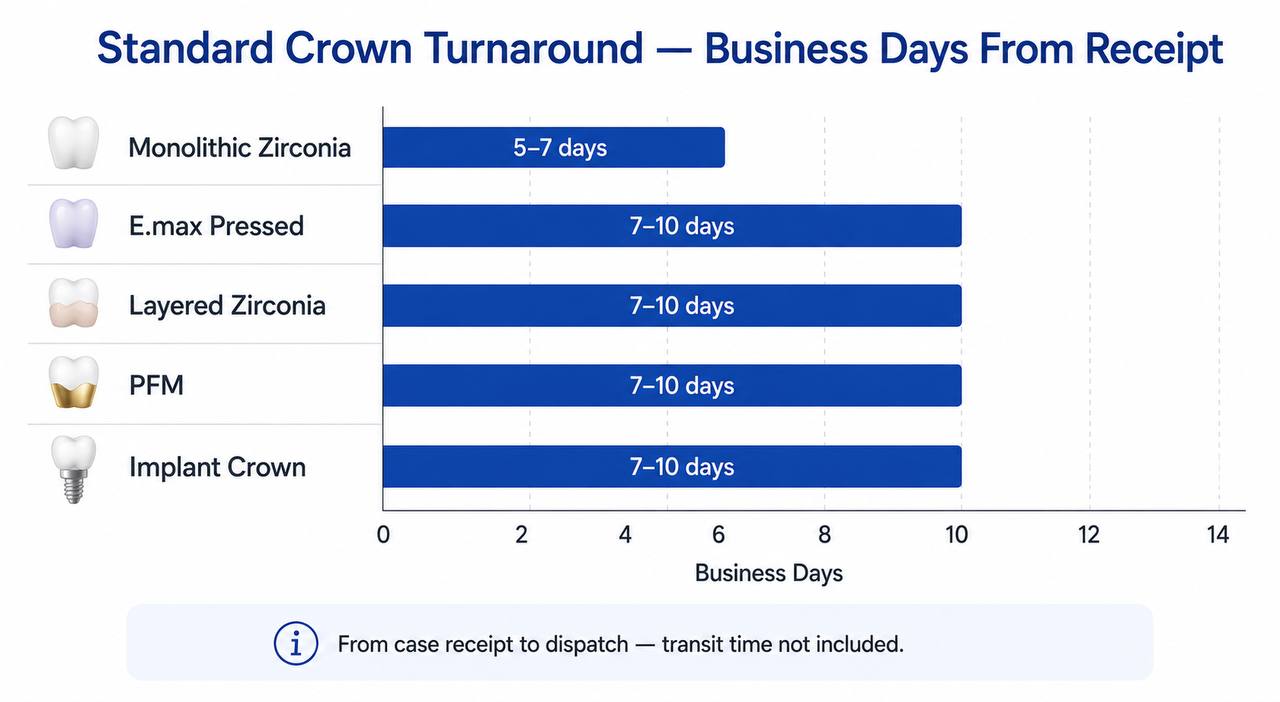
These are BioDent’s standard turnaround times — measured from the day the case is received at the laboratory to the day it ships back to the practice, not including transit time in either direction.
Single-Unit Monolithic Zirconia Crown
Standard: 5–7 business days.
This is the most common case type and the most straightforward fabrication workflow. Design from scan or model, mill, sinter, stain, glaze, quality check, ship. The sintering cycle alone requires several hours at controlled temperature — it cannot be shortened without compromising the crown.
What extends this timeline: cases that arrive as traditional impressions add one to two days for model work. Cases with unusual shade requests or multiple staining passes add one day.
Cases with unclear margin definition require contact with the practice before fabrication begins.
Single-Unit E.max Crown (Pressed)
Standard: 7–10 business days.
Pressed e.max involves more manual technician steps than milled zirconia. The wax-up, investing, pressing, crystallization, and staining or characterization sequence requires more firing cycles than a standard zirconia case. Each firing cycle takes hours. There is no mechanical shortcut.
What extends this timeline: cases requiring significant custom characterization, veneer cases with multiple value and hue adjustments, and cases where the initial press does not meet quality standards and needs to be remade internally before shipping.
Single-Unit Layered Zirconia Crown
Standard: 7–10 business days.
The zirconia coping mills in the same timeframe as monolithic zirconia. The ceramic layering that follows involves multiple hand-application and firing cycles — each cycle takes several hours, and most layered cases require three to five firings to achieve the target shade and surface texture. This is skilled ceramist work and cannot be mechanically accelerated.
What extends this timeline: cases with complex shade matching across multiple adjacent crowns, significant custom characterization requests, and cases where shade verification at an intermediate firing stage requires practice input before completion.
PFM Crown
Standard: 7–10 business days.
PFM fabrication involves metal casting, opaquing, and multiple ceramic firing cycles. The casting process alone — waxing, investing, casting, devesting, finishing — takes a full day before ceramic work begins. In a well-organized laboratory the workflow is efficient, but the physical steps cannot be compressed below their minimum time requirements.
Implant-Supported Single Crown
Standard: 7–10 business days.
Implant crowns require accurate implant position data before design can begin, and the design process typically involves more verification than a tooth-supported crown — emergence profile, connection accuracy, and screw channel position all require additional attention. The fabrication steps after design follow the same material timeline as the corresponding crown type.
What extends this timeline: missing or incorrect implant system information requiring contact with the practice, custom abutment fabrication when requested alongside the crown, and cases involving angled screw channels that require additional design iterations.
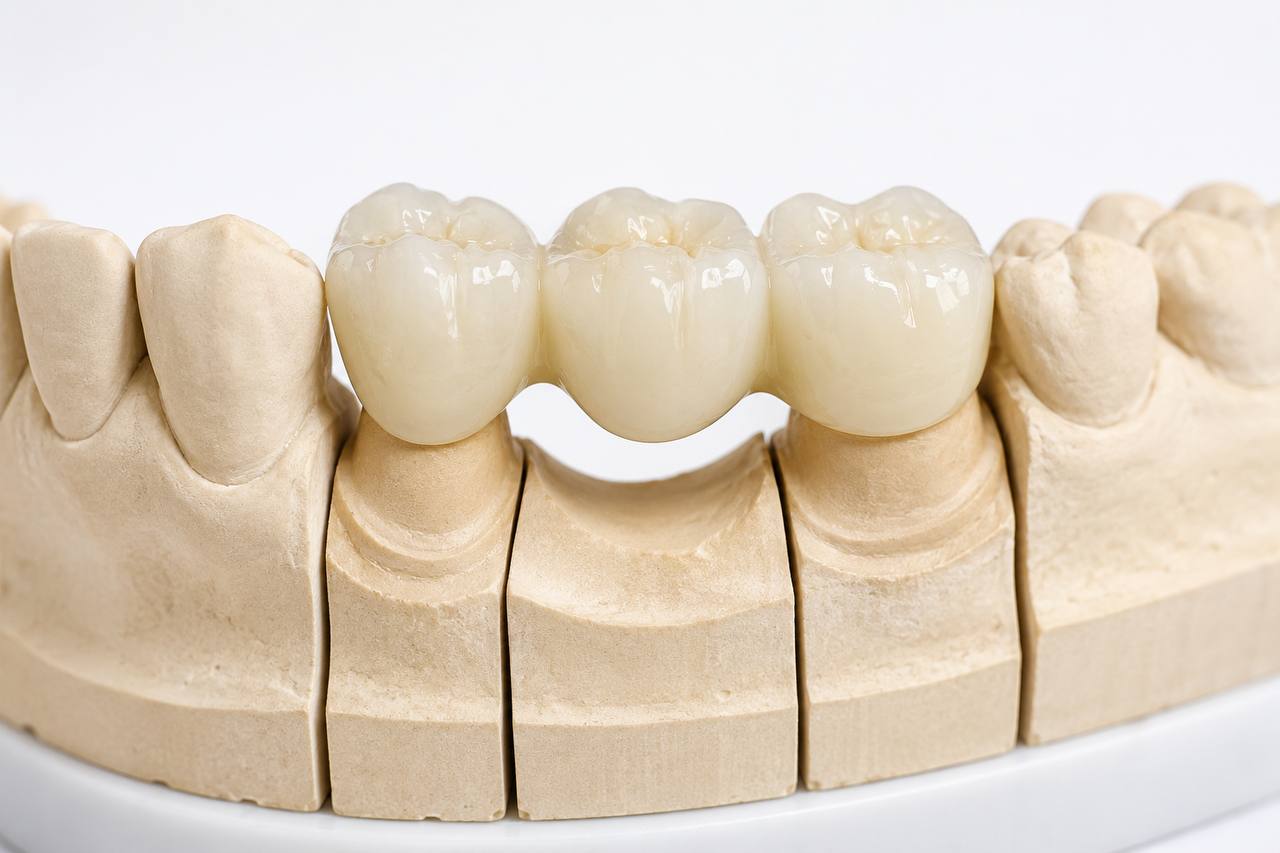
Multi-Unit Bridge (Three to Four Units)
Standard: 8–12 business days.
Bridges involve more complex design — inter-abutment relationships, pontic form, contact design across multiple units — and the fabrication of a single connected structure where any fit issue at one connection affects the whole. Design review and quality control take longer than for single units.
What extends this timeline: cases requiring articulated model work for occlusal verification, cases with significant cantilever design, and analog cases that require careful mounting and verification before design begins.
Full-Coverage Provisional Crown (PMMA or Bis-Acryl)
Standard: 2–3 business days.
Provisionals are the fastest case type BioDent fabricates. Milled PMMA provisionals from a digital scan can be processed same-day in some circumstances. Traditional provisional cases from diagnostic wax-ups or preparation scans are typically returned within two to three days.
Same-day provisional service is available for urgent cases — contact BioDent directly to confirm availability before sending the case.
Complete Denture
Standard: 10–15 business days for a standard two-appointment workflow.
A complete denture involves multiple stages — record base and wax rim, try-in, final processing — that require practice appointments between laboratory stages. The total calendar time from case start to delivery is typically four to six weeks when appointment intervals are factored in, even when each individual laboratory stage is completed promptly.
Rush Service: What It Is and What It Is Not
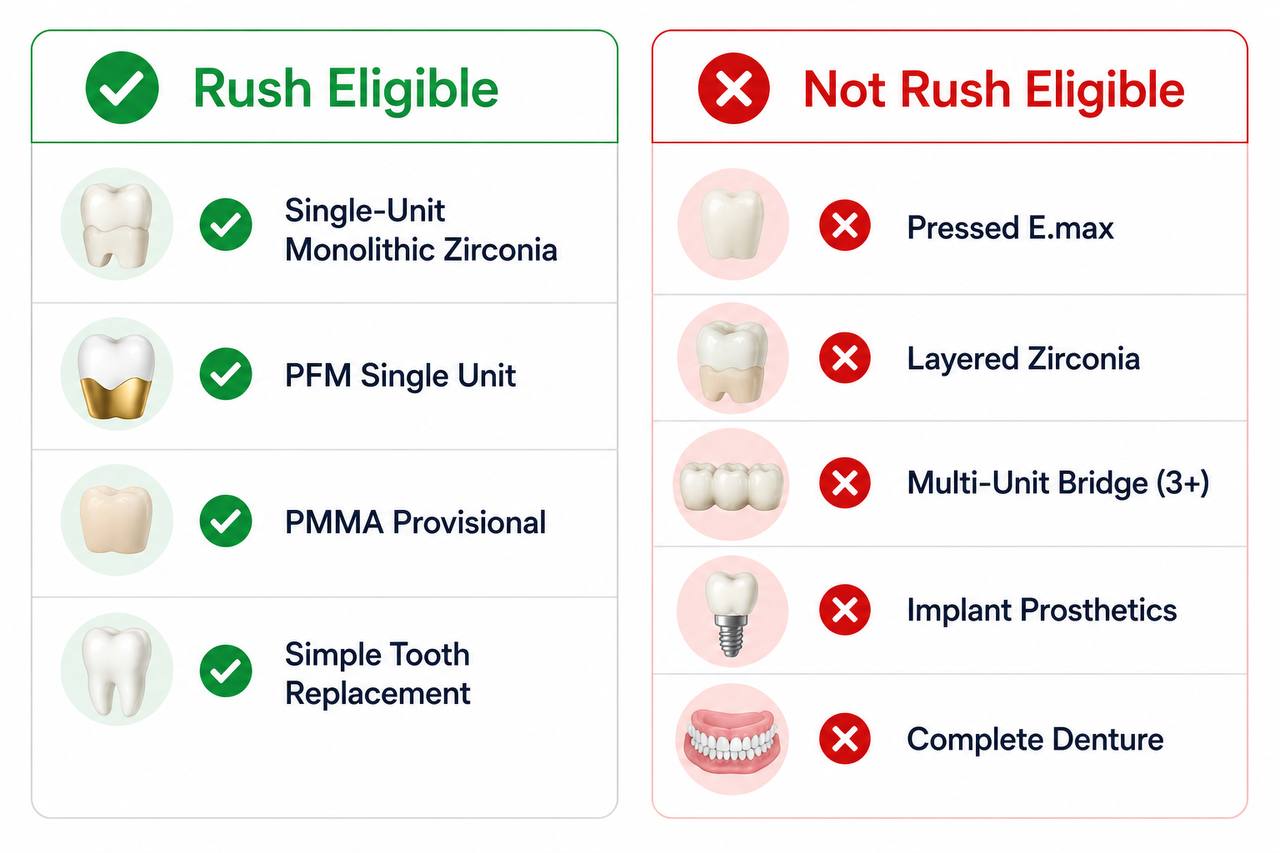
BioDent offers rush service for eligible case types. Rush turnaround for single-unit monolithic zirconia and simple PFM cases is typically two to three business days from receipt of a complete, clean case.
Rush service is not available for all case types. Pressed e.max, layered zirconia, multi-unit bridges, and any implant prosthetics are not eligible for same-day or next-day turnaround. The material and fabrication requirements do not permit it — and a lab that claims otherwise is cutting steps that affect quality.
Rush service is also not a substitute for planning. A case that needs to be rushed because the appointment was scheduled before the lab was contacted is an avoidable problem. Building lab turnaround time into treatment scheduling — rather than around it — eliminates most rush situations.
Rush fees apply to all rush cases. The fee reflects actual additional cost: technicians working the case outside normal production sequence, priority scheduling, and expedited shipping. If rush fees are a regular occurrence in your practice, the scheduling process is the problem, not the lab.
How to Build Lab Turnaround Into Your Schedule
The practices that have the fewest delivery-day problems are the ones that schedule backwards from the lab — not the ones that schedule the delivery appointment first and then hope the lab fits into the gap.
The workflow looks like this: confirm the preparation appointment date, add the laboratory turnaround time for the case type, add transit time in both directions, and schedule the delivery appointment from that total. For a single-unit zirconia crown with five-day turnaround, two-day outbound shipping, and two-day return shipping — a preparation on Monday of week one should have its delivery appointment no earlier than Wednesday of week three to provide a realistic buffer.
Most practices build tighter timelines than this and absorb the stress when something goes wrong — a scan that needs to be retaken, a case held for missing information, a shipping delay. Building a realistic buffer into the schedule converts those stress events into non-events.
What Slows Cases Down — and What You Can Do About It
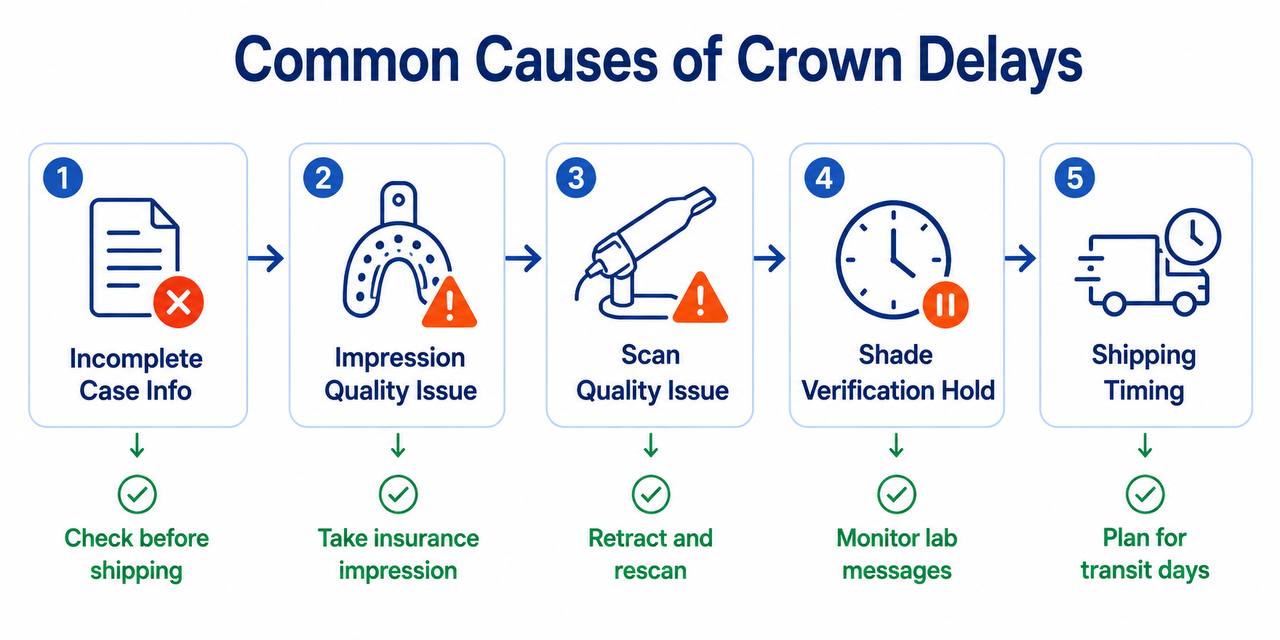
Most delays in laboratory turnaround originate on the practice side of the workflow, not the laboratory side. Understanding the common causes allows you to eliminate most of them.
Cases sent with missing information.
A case that arrives without shade, without a bite registration, or with unclear margin definition cannot proceed until the laboratory reaches the practice and gets answers. The case sits until that communication happens. This is the single most common cause of delay — and it is entirely preventable by checking the case before it ships.
Traditional impressions that need to be repoured. A VPS impression that tears at the margin, has voids in critical areas, or was not poured within the appropriate time window may need to be repoured from the original impression or returned to the practice for a retake. Either outcome adds days to the timeline. Taking an additional final impression at the time of preparation — an insurance impression — prevents retake situations.
Scan quality issues. A digital scan with tissue interference at the margin, saliva contamination, or stitching artifacts requires either supplementary information from the practice or a retake. BioDent will contact the practice before proceeding with a compromised scan rather than fabricating a crown that will not fit.
Shade verification holds. Some complex shade cases require intermediate shade verification before the laboratory completes finishing. If the practice is not available to respond promptly to shade check requests, the case waits. Designating a team member to monitor and respond to laboratory communications promptly eliminates this delay.
Shipping delays. Transit time is not laboratory turnaround time. A case that ships on Friday from the practice and arrives at the laboratory Monday has lost two transit days. For cases with tight timelines, understanding carrier schedules and pickup times at your office matters.
Frequently Asked Questions
Can BioDent guarantee turnaround time on every case?
Standard turnaround times apply to cases received complete and clean — meaning all required information is present, impressions or scans are acceptable quality, and instructions are clear. Cases that arrive incomplete or require contact with the practice before fabrication begins cannot be guaranteed to meet standard turnaround from the original receipt date.
What counts as the start date for turnaround?
The day the case is received at BioDent’s facility in complete, workable condition. A case received Monday with missing information that is resolved Wednesday starts its turnaround clock on Wednesday, not Monday.
Does BioDent charge extra for rush cases?
Yes. Rush fees apply to all cases processed outside standard turnaround. The fee varies by case type and turnaround requested. Contact BioDent for current rush pricing.
What if my case is delayed on BioDent’s side?
BioDent will contact you proactively if a case cannot meet its quoted turnaround due to a laboratory-side issue. In cases of laboratory error or quality failure requiring a remake, turnaround on the remake is prioritized and no remake fee is charged.
How does transit time affect the overall timeline?
BioDent ships via FedEx and UPS with tracked service. Standard outbound shipping from practices to BioDent in New Jersey takes one to three business days depending on location. Return shipping is typically one to two days to most of the continental US.
Build three to five days of transit time into your total timeline calculation.
Is same-day service ever available?
For simple single-unit monolithic zirconia cases and provisional crowns received before the morning cutoff, same-day service may be available. Contact BioDent directly to confirm before sending the case — same-day availability depends on current production load.
Work With a Lab That Respects Your Schedule
BioDent provides realistic turnaround estimates on every case — not the most optimistic number we can quote to win the business. When a case arrives complete, we meet our quoted timeline. When something requires clarification, we contact you the same day rather than holding the case silently.
Also relevant: How to Choose a Dental Lab · Digital vs Traditional Impressions · Zirconia Crown Cost: Lab Pricing Explained