Digital vs. Traditional Impressions: An Honest Answer From the Lab
The question comes up constantly in continuing education, at study clubs, and in equipment purchase conversations: should you switch to digital impressions?
Most of the answers dentists hear come from equipment manufacturers, consultants with referral arrangements, or colleagues who recently invested in a scanner and need to believe it was the right decision. What you hear less often is a direct, unfiltered answer from the laboratory that actually works with the impression after you take it.
This is that answer. BioDent receives both digital and traditional impressions daily. We have a clear view of where each workflow performs well, where each creates problems, and what actually produces the better laboratory result — case type by case type.
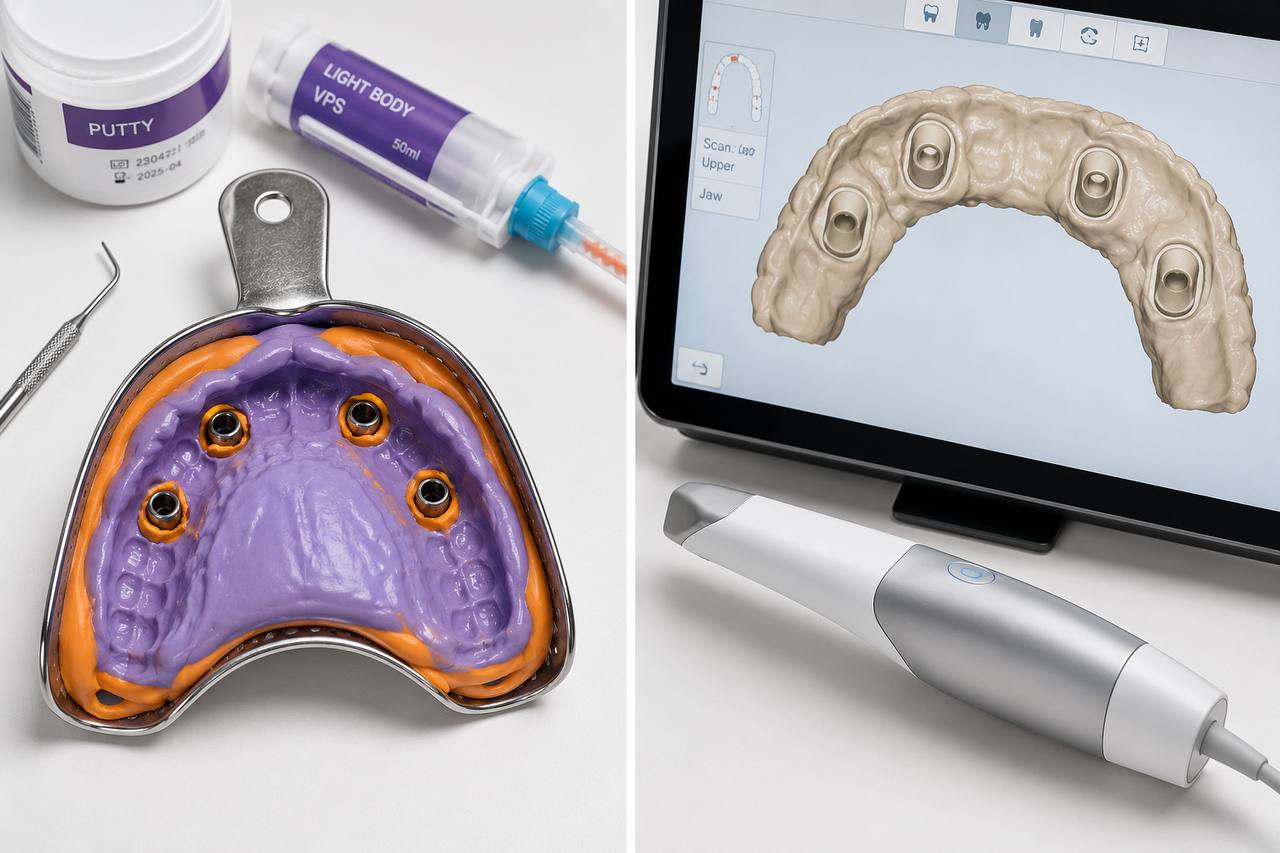
What the Lab Actually Receives — and What It Does With It
Understanding the laboratory’s perspective starts with understanding what happens to your impression after it leaves your office.
A traditional impression arrives in a sealed bag inside a rigid container. The laboratory pours it in stone, waits for the stone to set, trims the model, mounts it on an articulator, and begins fabrication from the physical model. Every step in that chain introduces potential for dimensional change — the impression material continues to polymerize slightly after removal, the stone shrinks marginally as it sets, and the mounting process introduces its own variables.
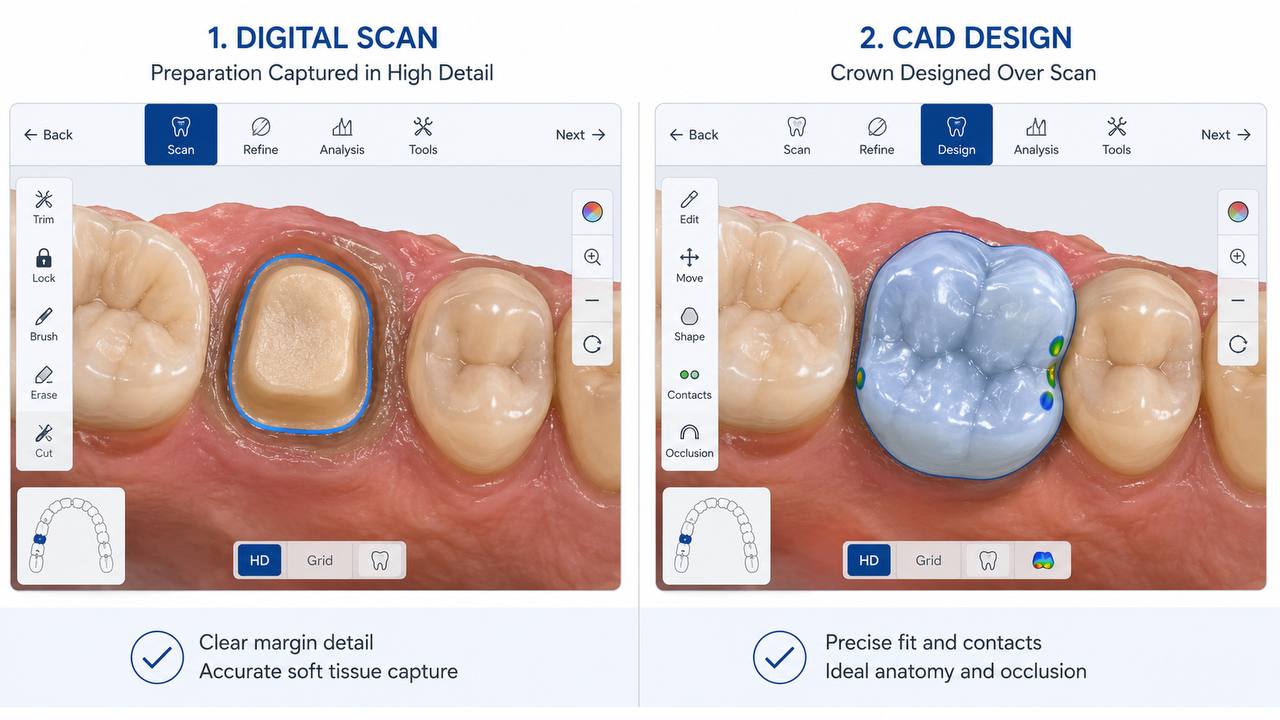
A digital scan arrives as a file. The laboratory imports it into CAD software, aligns the scan data, designs the restoration digitally, and sends the file to the milling machine or to a printer. There is no stone, no pouring, no mounting. The dimensional chain from preparation to milled crown is shorter and has fewer steps where error can accumulate.
That is the structural advantage of digital: fewer steps between the preparation and the final restoration. Whether that advantage is realized in practice depends entirely on the quality of the scan.
Where Digital Impressions Are Genuinely Better
For straightforward single-unit and multi-unit cases in accessible posterior and anterior regions, a high-quality digital scan from a well-maintained scanner produces superior results compared to a traditional impression in most circumstances. This is not a marketing claim — it is what BioDent’s technicians observe in the quality and fit of restorations fabricated from well-executed digital cases versus analog ones.
Single-unit posterior crowns are where digital workflow demonstrates its clearest advantage. The preparation is in an accessible location, the scanner can capture the margin without interference from soft tissue in most cases, and the digital-to-milling workflow eliminates the stone model variables entirely. A clean scan of a well-prepared molar produces a restoration that seats precisely with minimal adjustment.
Short-span anterior bridges benefit from digital’s accuracy across span. A three-unit anterior bridge fabricated from a high-quality digital scan has precise inter-abutment relationships that are difficult to replicate from a poured stone model without articulator mounting and verification.
Cases requiring design approval. One genuine clinical advantage of digital workflow that has nothing to do with impression accuracy: the laboratory can share the proposed restoration design with you before milling. You can review crown morphology, contact points, and occlusal design, and request modifications before fabrication begins. This feedback loop is not available with traditional impressions.
Speed. A digital scan transmitted to BioDent the same day preparation is completed begins the design process immediately. There is no shipping time for the impression, no pouring delay. For practices with tight scheduling windows, this matters.
Where Traditional Impressions Still Win
Digital has real advantages. It also has genuine limitations that scanner manufacturers understate and that show up clearly in laboratory work.
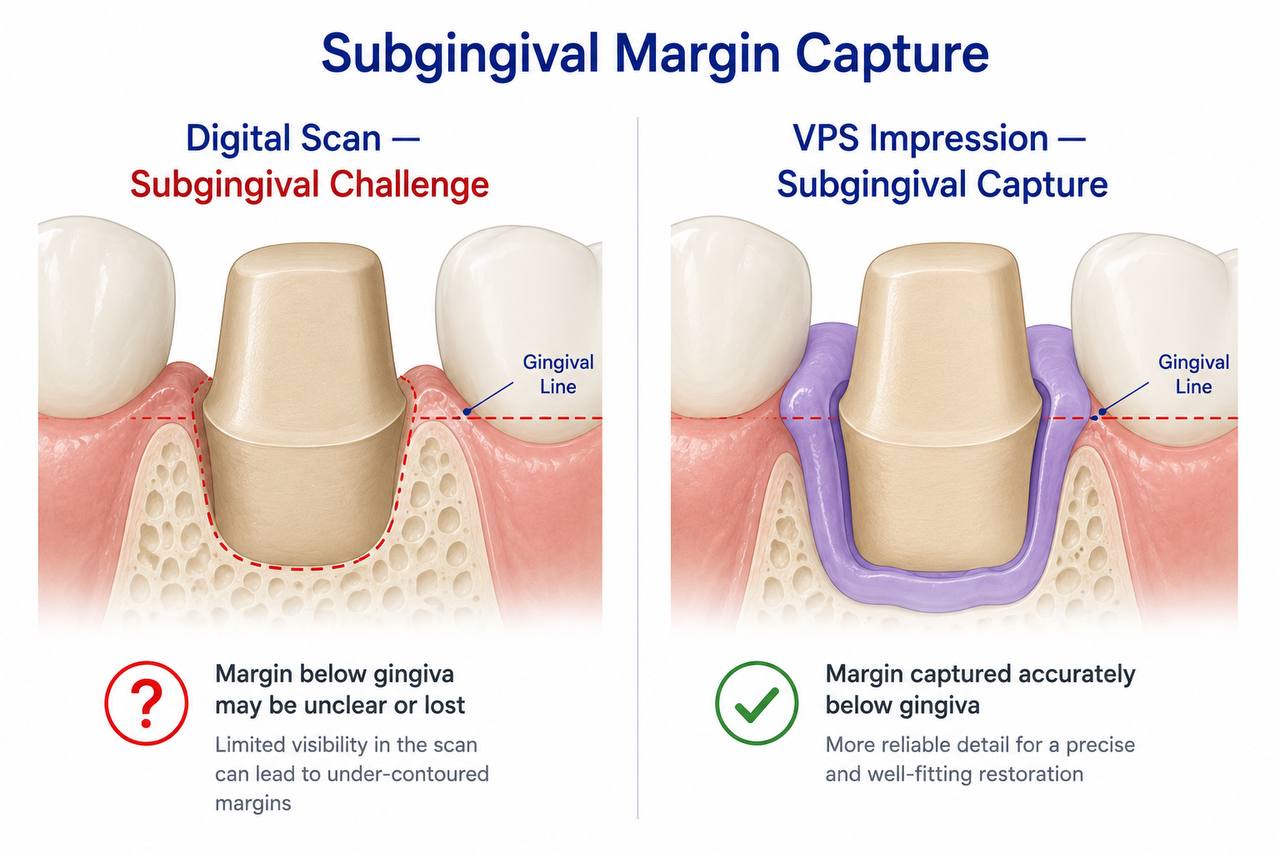
Subgingival margins. This is the most significant limitation of current intraoral scanning technology. When a margin is placed one millimeter or more below the gingival crest — common in posterior restorations, crown lengthening cases, and cases with deep decay — capturing it accurately with a scanner requires retraction, isolation, and often multiple scan attempts. Blood, saliva, and soft tissue movement all degrade scan accuracy in ways that a properly taken VPS impression does not. A clean gingival retraction cord, good hemostasis, and a well-executed VPS impression captures a subgingival margin more reliably than most clinical scanning situations.
Full-arch impressions for removable prosthetics. Complete dentures, partial dentures, and implant overdentures that require tissue-bearing surface detail benefit from impression techniques specifically designed to capture functional anatomy — border mold, functional impressions, and custom trays. Current intraoral scanners do not replicate this workflow. BioDent receives digital scans for removable cases and can work with them, but the functional impression technique for dentures exists because it captures clinical information that an optical scan does not.
Posterior isolation challenges. Scanners require a dry, saliva-free, blood-free field. In patients with high salivary flow, significant bleeding, or limited mouth opening, achieving consistent scan quality is clinically difficult. An experienced assistant taking a VPS impression under these conditions will produce a more usable result than a compromised scan.
Cases requiring facebow and CR records. Full mouth rehabilitation and complex occlusal cases often rely on facebow transfer and verified centric relation records. While digital workflows can incorporate bite registration scans, the precision of a mechanical articulator mounted from a facebow transfer remains the standard for complex cases. Many laboratories, including BioDent, use both — digital scans for crown and bridge design, articulated models for complex occlusal management.
What BioDent’s Technicians Actually Prefer — By Case Type
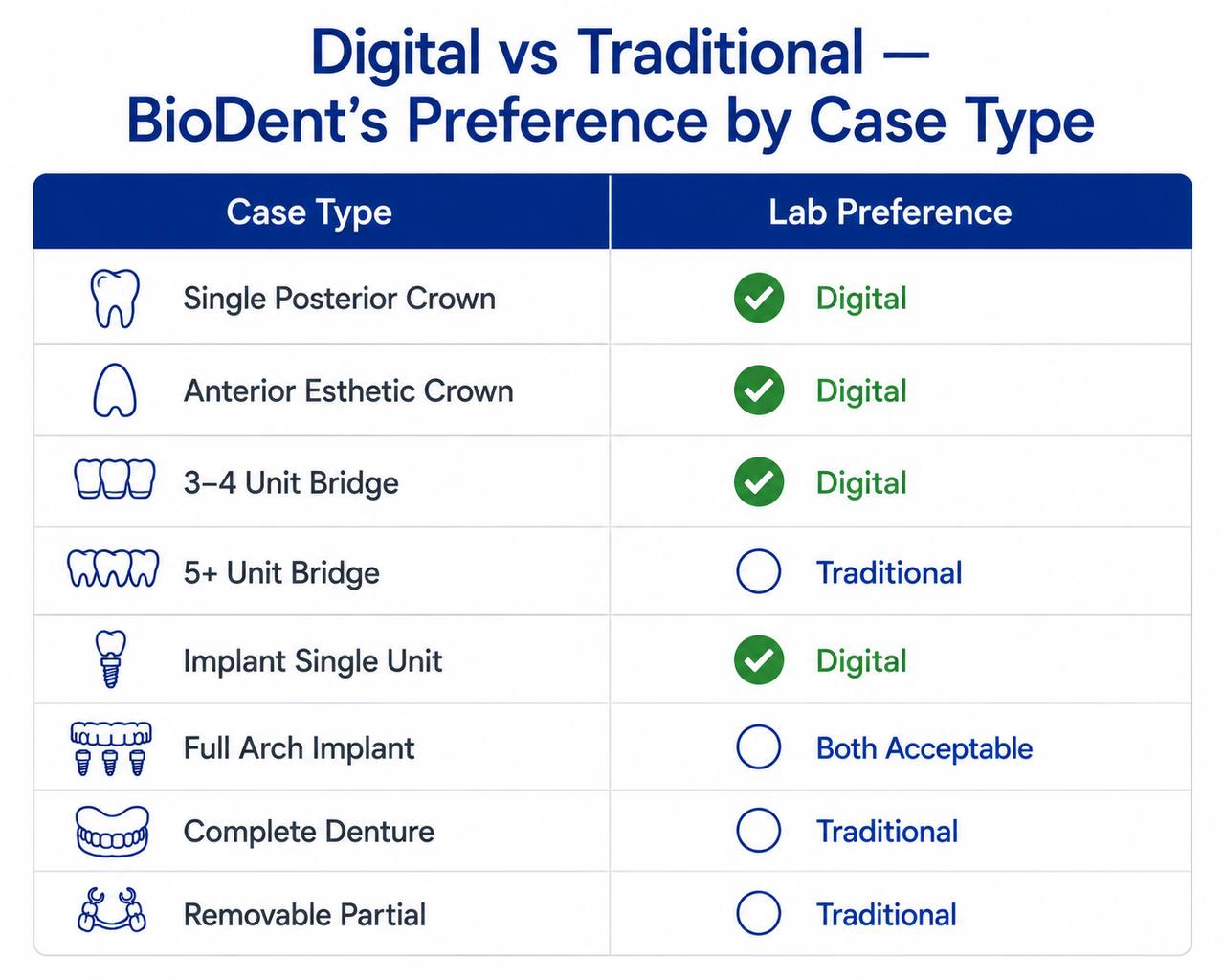
This is the direct answer to the question in the title. Not a diplomatic “both have advantages” — an honest breakdown by case type.
Single-unit posterior crown: Digital preferred. A high-quality scan from any major system produces a result that is equal to or better than a traditional impression for this case type. If you have a scanner, use it.
Single-unit anterior crown in esthetic zone: Digital preferred for fit. Traditional remains competitive for shade and surface texture reference — photographs matter here alongside or instead of shade matching from a scan.
Three to four unit posterior bridge: Digital preferred with a well-maintained scanner. The accuracy across span is good enough for most bridge cases with current scanner technology.
Five or more unit bridge: Traditional impression or digital with scan-to-model workflow preferred. Long-span bridges require verified inter-abutment relationships that benefit from articulated model review before fabrication.
Full arch — fixed implant prosthesis: Scan with verified scan bodies preferred for digital cases. Traditional open-tray implant impression with splinted copings remains the most reliable option for many full-arch cases. Both are acceptable; the quality of execution matters more than the technique.
Complete denture: Traditional functional impression. No current digital workflow replicates functional impression technique reliably enough for BioDent to prefer it for complete denture fabrication.
Removable partial denture: Traditional preferred. Framework design benefits from articulated model with documented occlusal relationships.
Implant single unit: Digital with correct scan body strongly preferred. The elimination of stone model variables is a significant advantage for implant crown fit.
The Real Variable: Scan Quality, Not Scanner Brand
BioDent receives scans from every major intraoral scanner on the market: iTero Element 5D, 3Shape TRIOS 5, Carestream CS 3800, Planmeca Emerald, Medit i700, and others. From a fabrication standpoint, the brand matters less than the quality of the individual scan.
A scan with soft tissue interference at the margin, saliva contamination, stitching artifacts across multiple scan passes, or an incomplete opposing arch capture is a problem regardless of which scanner produced it. A clean, complete scan from any of the major systems produces a usable result.
What the laboratory looks for when a scan arrives: clear margin visibility with no tissue overlap, complete preparation capture with no voids, a complete opposing arch, a bite registration that relates the arches accurately, and complete gingival contour data around the preparation.
When any of these elements is missing or compromised, BioDent contacts the practice before fabrication. Proceeding from an incomplete scan produces a crown that may not fit at delivery — which costs the practice more time than the call to retake the scan.
If you have a scanner and your restorations frequently need significant adjustment at delivery, scan quality and technique are the first place to look. BioDent can review scan quality and provide feedback on what is causing the fit issue.
Making the Switch: What to Expect in the First Thirty Cases
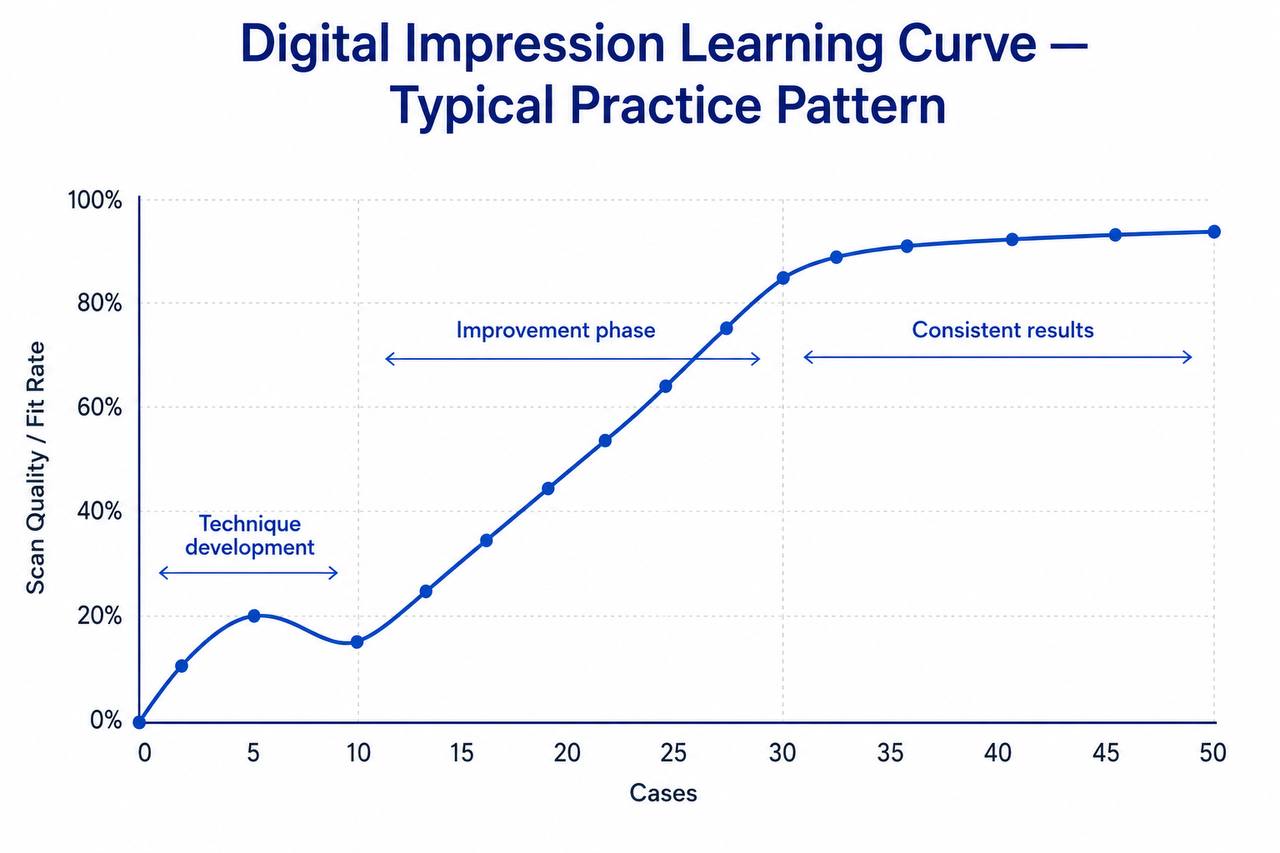
If your practice is transitioning from traditional to digital impressions, the first thirty cases are a learning period.
Scan technique has a learning curve that most practices underestimate because the equipment itself is easy to operate — the challenge is developing consistent clinical technique for margin capture, isolation, and scan sequencing.
BioDent sees a consistent pattern in new digital practices: early scans are often incomplete or have margin capture issues, fit rates improve significantly between cases fifteen and thirty as technique develops, and by cases thirty to fifty the practice is producing scans consistently enough that digital advantages are clearly realized.
During the transition period, do not abandon traditional impressions entirely. Use digital for straightforward cases and traditional for complex cases or situations where you are not yet confident in your scan quality. A mixed workflow during the learning period produces better outcomes than forcing digital on every case before technique is established.
BioDent’s team is available to review scan quality and provide specific technical feedback during the transition. If a case arrives with a compromised scan, we will tell you what the problem is and how to avoid it on the next case.
Frequently Asked Questions
Does BioDent accept all digital scan formats?
Yes. BioDent accepts files from iTero, 3Shape TRIOS, Carestream, Planmeca, Medit, and other major systems. Contact us to confirm format compatibility if you are using a less common scanner.
What file format should I send?
STL files are the most universally compatible format. Most scanners export STL natively or convert to it. Some scanners also support OBJ or proprietary formats that BioDent can accept directly. Confirm with our team when submitting your first digital case.
My digital cases have more adjustment at delivery than my traditional cases. Why?
The most common causes are margin capture issues — soft tissue overlapping the finish line, saliva contamination, or insufficient retraction — and scan stitching errors across multiple passes. Send BioDent the scan file and we can identify the specific issue. Fit problems that originate in the laboratory are uncommon with clean scan data.
Can BioDent provide design approval before milling digital cases?
Yes, on request. For esthetic cases, complex morphology requests, or when you want to verify the proposed design before fabrication, BioDent can share the digital design for your review and approval. Note this request on your prescription.
Does using a digital scanner qualify my practice for BioDent’s free iTero program?
BioDent’s free iTero scanner program is available for qualifying practices. See our free iTero scanner program page for eligibility details and how to apply.
Send Your First Digital Case to BioDent
BioDent accepts digital cases from all major scanner systems and provides direct feedback on scan quality. For practices transitioning to digital workflow, we offer case-by-case review and technical guidance at no additional charge.
Also relevant: How to Choose a Dental Lab · Free iTero Scanner Program for Dentists · All-on-4 Lab Requirements